
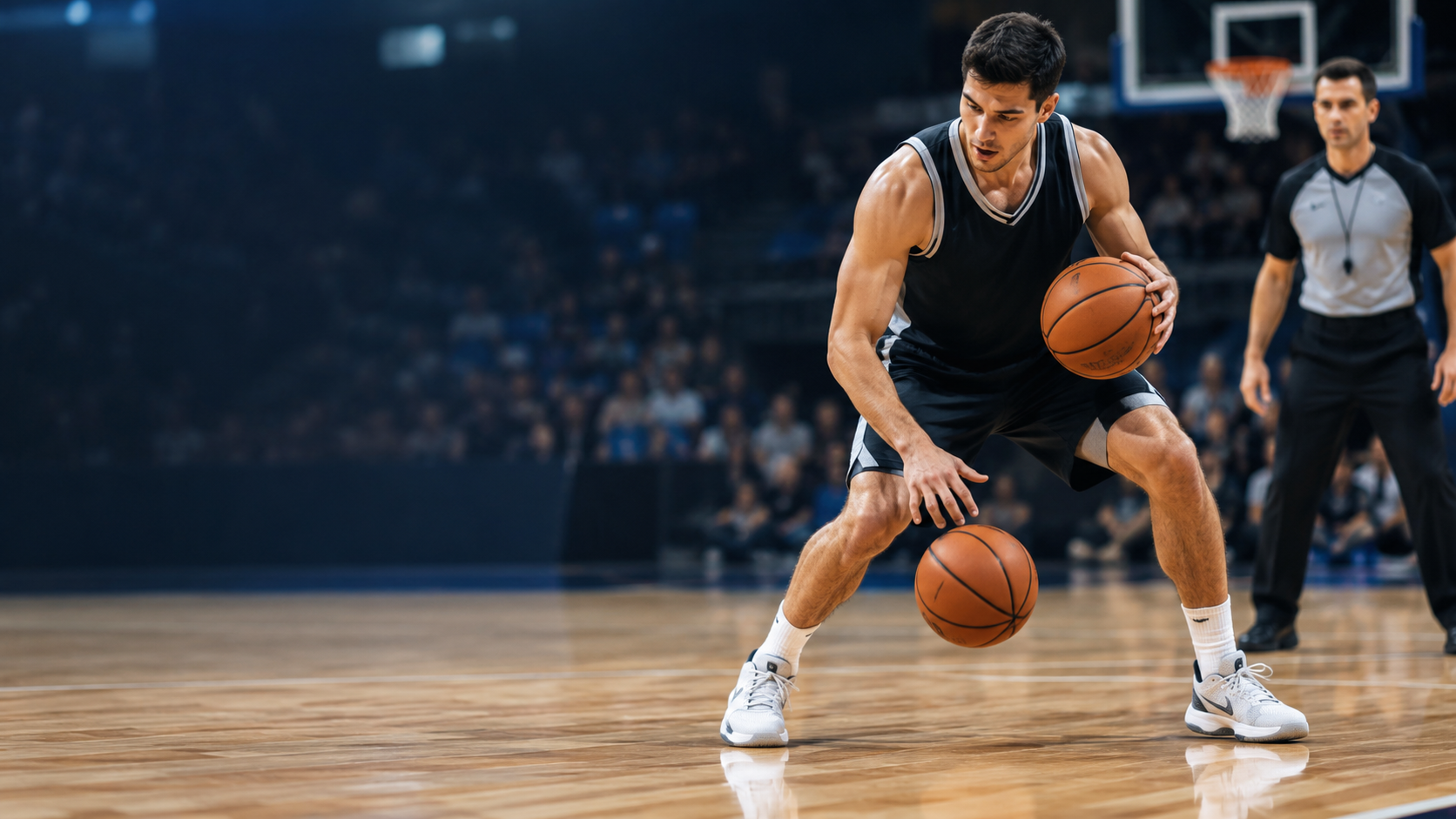
A double dribble in basketball is a violation that occurs when a player stops their first dribble and then starts dribbling again without a legal reason to do so.
In simple terms, you generally cannot dribble, stop your dribble, and then dribble again.
For example, a player dribbles the ball down the court, picks it up with both hands, and then puts the ball back on the floor to dribble again. That is a double dribble violation.
However, the rule is more detailed than that. A player can sometimes lose control of the ball, regain it, and legally continue playing. That is why understanding control, fumbles, and when a dribble actually ends is important.
Under FIBA rules, a player may start a second dribble after certain situations, including losing control because of a shot, a touch by an opponent, or a pass or fumble involving another player.
What Is a Double Dribble in Basketball?
A double dribble happens when a player dribbles the ball, ends that dribble, and then begins another dribble without a permitted exception.
The basic sequence looks like this:
First dribble → dribble ends → player starts another dribble = double dribble
For example:
- A player dribbles with their right hand.
- The player stops and gains control of the ball.
- The player puts the ball back on the floor.
- The player begins dribbling again.
That is a double dribble.
The important question is therefore not simply, “Did the player touch the ball twice?”
The better question is:
Did the player’s first dribble end before they started another dribble?
That distinction explains many of the plays that can look like double dribbles but are actually legal.
When Does a Dribble End?
Understanding when a dribble ends is the key to understanding a double dribble.
Under FIBA Article 24, a dribble ends when the player:
- touches the ball with both hands simultaneously, or
- allows the ball to come to rest in one or both hands.
FIBA also prohibits a player from putting the hand underneath the ball and carrying it or bringing it to a pause before continuing the dribble.
So, if a player is dribbling and then clearly gains control of the ball with both hands, the original dribble has ended.
If that player subsequently puts the ball back on the floor and starts dribbling without a legal exception, it is a double dribble.
Example
A player dribbles toward the basket and catches the ball with both hands.
The player then decides not to shoot and puts the ball back on the floor.
Violation: double dribble.
The first dribble ended when the player gained control of the ball. Starting another dribble is not normally permitted.
Is Picking Up the Ball a Double Dribble?
Picking up the ball does not automatically mean a double dribble has occurred.
The important issue is whether the player’s dribble has ended and whether they subsequently begin another dribble.
For example, a player can legally pick up the ball after completing a dribble and then:
- pass,
- shoot,
- pivot within the applicable rules, or
- come to a legal stop.
What the player generally cannot do is pick up and control the ball, stop the first dribble, and then simply begin dribbling again.
That is the classic double-dribble situation.
What Counts as a Legal Dribble?
A dribble begins when a player who has control of a live ball throws, taps, rolls, or bounces it on the court and touches it again before it touches another player.
During a FIBA dribble, the player may also throw the ball into the air as long as the ball touches the court or another player before the player touches it again.
There is no limit to the number of steps a player may take while the ball is not in contact with their hand during the dribble.
Example
A player pushes the ball several feet ahead of them, runs after it, and touches it again after it has bounced on the court.
That can be part of one continuous dribble.
The player does not automatically commit a double dribble simply because they took several steps while the ball was away from their hand.
What Is a Fumble in Basketball?
One of the most important parts of understanding the double-dribble rule is knowing the difference between a dribble and a fumble.
Under FIBA rules, a player who accidentally loses and then regains control of a live ball is considered to have fumbled the ball. A fumble is not automatically treated as a new dribble.
This is particularly important because a play can look awkward without actually being a violation.
Example 1: Dropped catch
A player receives a pass but fails to catch it cleanly.
The ball:
- touches the player’s hands,
- falls to the floor,
- and the player regains control.
That is a fumble, not automatically a dribble.
The player may then be able to legally begin a dribble.
Example 2: Losing control after a dribble
A player has completed a dribble and gains control of the ball, but accidentally fumbles it.
The ball hits the floor and the player regains control.
The situation needs to be judged according to the applicable rules, but an accidental loss of control is not automatically the same thing as voluntarily ending a dribble and starting another one.
The FDBA source specifically highlights this distinction and explains that accidental loss of control is a fumble rather than a dribble.
What Is NOT Considered a Dribble?
FIBA specifically identifies several actions that are not dribbles, including:
- successive shots for a field goal,
- fumbling at the beginning or end of a dribble,
- attempts to gain control by tapping the ball around other players,
- tapping the ball from another player’s control,
- deflecting a pass and gaining control,
- tossing the ball from hand to hand before it touches the court, provided there is no traveling violation, and
- throwing the ball against the backboard and regaining control.
This matters because not every time a player touches or moves the ball is counted as a dribble.
When Can You Dribble Again After Your First Dribble?
There are important exceptions to the second-dribble rule.
Under FIBA Article 24, a player cannot dribble for a second time after the first dribble has ended unless, between the two dribbles, the player lost control of the ball because of:
- A shot for a field goal
- A touch of the ball by an opponent
- A pass or fumble that has touched or been touched by another player
These exceptions are essential when determining whether a second dribble is legal.
Can You Dribble Again After Taking a Shot?
Under FIBA rules, losing control because of a legitimate field-goal attempt can allow the player to regain the ball and start another dribble.
For example:
A player ends a dribble, attempts a field goal, misses, and regains control.
Under the FIBA rule, the player can start a new dribble after that shot.
The FDBA source also emphasizes that the shot does not necessarily have to touch the ring for this exception to apply; the relevant issue is that it was a legitimate attempt for a field goal.
Rules can differ between basketball organizations, so players should check the rule set governing their competition.
Can You Dribble Again If an Opponent Touches the Ball?
Yes, under the FIBA second-dribble exception, a player can start another dribble if they lost control because an opponent touched the ball.
Example
A player finishes their dribble and attempts to pass.
A defender touches the pass and knocks it away.
The offensive player regains control.
The offensive player can then legally begin another dribble under the FIBA rule.
This is different from simply throwing the ball at the defender yourself.
Can You Throw the Ball at an Opponent to Start a New Dribble?
No.
This is one of the most interesting double-dribble examples in the rules.
Suppose a player has ended their dribble and deliberately throws the ball against an opponent’s leg. The player catches the ball and tries to start dribbling again.
That is still a double dribble under the FIBA interpretation.
Why?
Because the opponent did not touch the ball. The ball touched the opponent.
FIBA’s official interpretation specifically gives this example and rules it a double dribble violation.
The FDBA source includes the same example and explains the distinction: an opponent must actually touch the ball for the exception to apply; deliberately throwing the ball into the opponent does not create that exception.
What About a Pass That Gets Deflected?
A pass that is touched or deflected by another player can create an opportunity for the original player to regain control and start a new dribble under the applicable exception.
For example:
- Player A dribbles.
- Player A stops the dribble.
- Player A passes.
- A defender deflects the pass.
- Player A regains control.
- Player A starts dribbling again.
Under FIBA’s second-dribble rule, this can be legal because the player lost control after another player touched the ball.
Is Losing the Ball and Picking It Up Again a Double Dribble?
Not necessarily.
This is where the concept of control becomes extremely important.
If a player accidentally loses control of the ball and then regains it, the play may be a fumble rather than a second dribble.
The FDBA explanation specifically points out that a ball bouncing awkwardly or rising unusually high does not automatically make the action a carry or double dribble. The key question is whether the player actually maintained or regained control in a way covered by the rules.
Example
A player is dribbling and accidentally loses control.
The ball bounces high.
The player chases it, regains control, and continues playing.
The unusual bounce alone does not automatically make the play a double dribble.
The referee must determine what happened to the player’s control of the ball.
Double Dribble vs. Carrying
A double dribble and a carry are different violations, although they can sometimes look similar.
Double dribble
A player ends a dribble and then starts another dribble without a legal exception.
Example:
Dribble → pick up and control → dribble again.
Carrying
A player puts their hand underneath the ball or otherwise brings the ball to a pause while dribbling and then continues the dribble.
FIBA specifically prohibits placing any part of the hand under the ball to carry it from one point to another or bring it to a pause before continuing the dribble.
So the basic distinction is:
Double dribble = restarting a dribble after it has ended.
Carry = illegally controlling or pausing the ball during a dribble.
Double Dribble vs. Traveling
A double dribble is also different from traveling.
Double dribble
The issue is the dribble.
The player ends the dribble and then starts another one without a legal exception.
Traveling
The issue is foot movement while holding a live ball.
Under FIBA’s rules, traveling concerns illegal movement of one or both feet while holding the ball, subject to the applicable pivot-foot and step rules.
A player can therefore:
- commit a double dribble without traveling,
- commit a traveling violation without double dribbling, or
- commit neither violation.
Understanding whether the problem concerns the hands and dribble or the feet and pivot/steps makes the distinction much easier.
Is a Crossover a Double Dribble?
No.
A legal crossover is not a double dribble.
A crossover is simply a change of direction during a continuous dribble. The player moves the ball from one hand to the other while maintaining a legal dribble.
For example:
Right hand → bounce → left hand → continue dribbling
That is not automatically a double dribble.
The same principle applies to legal:
- between-the-legs moves,
- behind-the-back dribbles,
- spin moves,
- hesitation dribbles, and
- other changes of direction.
The question is whether the player illegally ends the dribble and then starts another one.
Is a Spin Move a Double Dribble?
Not by itself.
A player can perform a spin move while dribbling as long as the ball remains under legal control and the player’s footwork complies with the traveling rules.
The spin itself does not automatically end the dribble.
However, if the player gains control of the ball and then begins another dribble after the first dribble has ended, a double dribble can occur.
What Happens After a Double Dribble?
A double dribble is a violation, not a personal foul.
Once the referee calls the violation, the opposing team receives possession according to the applicable competition rules.
In FIBA basketball, violations are generally penalized by awarding the ball to the opponents for a throw-in at the place nearest to where the violation occurred, subject to the specific rules and exceptions governing the situation.
The practical result for a player is simple:
The team loses possession.
Why Do Referees Call Some Dribbles That Look Strange Legal?
Because appearance alone does not determine whether a double dribble occurred.
A player can lose control of the ball, fumble it, chase it, and regain it without committing a double dribble.
This is one of the central points made in the FDBA explanation: players and spectators may immediately shout “carry,” “double dribble,” or “travel” when a dribble looks unusual, but the referee has to determine whether the player actually violated the rule.
The key concept is:
Control.
A strange bounce is not automatically a double dribble.
A high bounce is not automatically a double dribble.
Losing control is not automatically a double dribble.
What matters is what happened to the player’s control of the ball and whether the player legally started another dribble.
Common Double-Dribble Examples
Here are some easy situations to remember.
Example 1: Pick up and dribble again
A player dribbles, catches the ball with both hands, waits, and starts dribbling again.
Double dribble.
Example 2: Legal crossover
A player dribbles from the right hand to the left hand in one continuous action.
Legal play.
Example 3: Accidental fumble
A player loses control of the ball accidentally and then regains it.
Not automatically a double dribble.
The play must be judged under the fumble and control rules.
Example 4: Defender knocks the ball away
A player ends a dribble, passes, a defender touches the ball, and the original player regains it.
A second dribble may be legal under FIBA rules.
Example 5: Throwing the ball against the defender’s leg
A player ends their dribble and deliberately throws the ball at the defender’s leg before catching it again.
Double dribble under FIBA’s official interpretation.
Example 6: Legal shot exception
A player ends a dribble, attempts a field goal, misses, regains control, and begins another dribble.
Potentially legal under FIBA rules because the loss of control occurred because of the field-goal attempt.
Common Mistakes Players Make
Players often commit double dribbles because they lose track of when their first dribble ended.
Common examples include:
- picking up the ball and then changing their mind,
- stopping a dribble and putting the ball down again,
- catching the ball with both hands and then trying to drive,
- assuming every loose-ball recovery allows another dribble,
- confusing a fumble with a legal continuation,
- confusing a carry with a double dribble, and
- deliberately throwing the ball at a defender and assuming it counts as a defensive touch.
The easiest way to avoid these mistakes is to recognize when you have clearly gained control of the ball.
How to Avoid a Double Dribble
If you’re a player, these habits can help:
1. Know when your dribble has ended
Once you clearly control the ball with both hands or otherwise bring it to rest, assume the dribble is over.
2. Decide before picking up the ball
Before ending your dribble, know whether you want to:
- shoot,
- pass, or
- stop and pivot.
Don’t pick up the ball and then decide that you want to continue dribbling.
3. Learn the difference between a fumble and a dribble
Accidental loss of control is not automatically a second dribble.
4. Don’t deliberately throw the ball at a defender
Under FIBA’s official interpretation, deliberately throwing the ball at an opponent does not create the opponent-touch exception.
5. Practice your ball-handling
Good control makes it easier to recognize when the ball is actually in your possession and when you have lost control.
What Is the Difference Between a Double Dribble and a Carry?
The easiest way to remember the difference is:
Double dribble: The first dribble has ended, and the player starts another dribble.
Carry: The player illegally places the hand underneath the ball or brings the ball to a pause while continuing the dribble.
Both violations involve illegal dribbling, but they occur in different ways.
What Is the Difference Between a Double Dribble and Traveling?
Remember:
Double dribble = dribbling problem.
Traveling = footwork problem.
If a player ends their dribble and starts dribbling again, think double dribble.
If a player moves their feet illegally while holding the ball, think traveling.
FIBA vs. NBA Double-Dribble Rules
The basic idea of a second dribble being prohibited is shared across basketball, but the detailed wording and interpretations can differ between governing bodies.
FIBA’s Article 24 defines the dribble, explains when it starts and ends, identifies fumbles, and lists the situations in which a second dribble is permitted.
The NBA also prohibits a player from dribbling a second time after voluntarily ending the first dribble. Its rulebook additionally uses a gather concept and lists situations such as a field-goal attempt, pass, loss of control, and certain defensive touches in its dribble rules.
So if you’re writing for a general basketball audience, it is better to explain the common principle first and then identify league-specific differences rather than presenting NBA and FIBA terminology as if they were identical.
Frequently Asked Questions About Double Dribbling
What is a double dribble in basketball?
A double dribble occurs when a player ends their first dribble and then starts dribbling again without a legal exception.
Is picking up the basketball a double dribble?
No. Picking up the ball is not itself a double dribble. The violation occurs when a player ends the dribble and then starts another dribble without permission under the applicable rules.
Can you dribble again after losing the ball?
Sometimes. An accidental loss of control can be considered a fumble, while certain situations allow a second dribble. Under FIBA rules, exceptions include a field-goal attempt, a touch by an opponent, or a pass or fumble involving another player.
Can you dribble again after a shot?
Under FIBA rules, yes, when the player loses control because of a field-goal attempt and then regains control.
Can you dribble again if a defender touches the ball?
Under FIBA rules, a player may start a second dribble if they lost control because of a touch of the ball by an opponent.
Can you throw the ball at a defender and dribble again?
Not under the FIBA interpretation of this situation. If the ball touches the defender rather than the defender touching the ball, the second-dribble exception does not apply.
Is a crossover a double dribble?
No. A legal crossover is part of a continuous dribble.
Is a carry the same as a double dribble?
No. A carry involves illegally placing the hand underneath the ball or bringing it to a pause during a dribble. A double dribble occurs when a player starts a new dribble after the first one has ended.
Is a fumble a double dribble?
Not automatically. A player who accidentally loses and regains control can be considered to have fumbled the ball.
Why do some players look like they double dribbled but don’t get called?
Because the appearance of the play is not enough to determine the violation. The referee must determine whether the player actually ended the dribble, maintained or lost control, and whether a rule exception applies.
The Simple Way to Remember the Double-Dribble Rule
If you only remember one thing, remember this:
You cannot normally dribble, stop your dribble, and then start dribbling again.
But don’t assume that every awkward ball movement is a double dribble.
A player can fumble the ball, lose control, recover a deflected pass, or regain possession after certain legal events and still be allowed to continue playing.
The central question is:
Did the player’s first dribble actually end, and if it did, was there a legal reason the player could start another one?
That is the key to understanding what a double dribble in basketball is.
Final Takeaway
A double dribble in basketball happens when a player ends their dribble and then begins another dribble without a permitted exception.
The most important concepts are:
- A dribble has a defined beginning and end.
- Touching the ball with both hands simultaneously can end the dribble.
- Allowing the ball to come to rest in the hand can end the dribble.
- A carry is different from a double dribble.
- Traveling is different from a double dribble.
- An accidental loss of control can be a fumble rather than a new dribble.
- Under FIBA rules, certain events can legally allow a second dribble.
- Deliberately throwing the ball at an opponent does not create the opponent-touch exception.
- The appearance of a play is not enough; control is the key issue.
Once you understand when a player’s dribble ends and when the rules allow control to be regained, the double-dribble rule becomes much easier to understand.
