
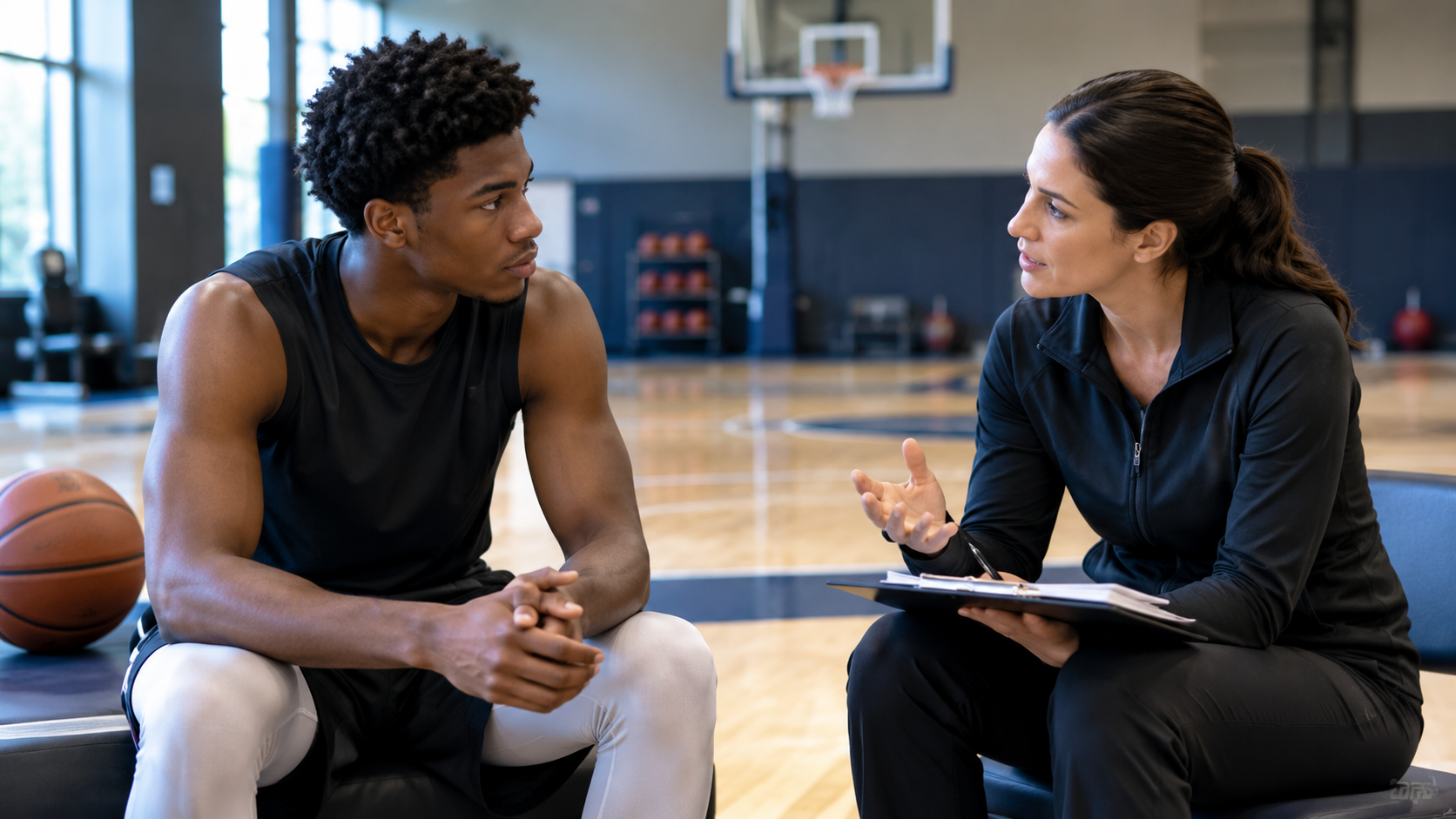
A basketball psychologist helps players develop the mental skills they need to perform consistently, handle pressure, recover from mistakes, manage confidence, and stay focused during competition.
Basketball is a fast, demanding sport. Players have to make decisions in seconds, respond to mistakes, communicate with teammates, manage emotions, and execute skills while under pressure. Physical training develops shooting, strength, speed, conditioning, and technique—but the mental side of basketball can also affect how consistently those skills show up in games.
A basketball psychologist, often working within the broader field of sport and performance psychology, applies psychological principles to help athletes improve performance and cope with psychological factors that can interfere with it. The American Psychological Association describes sport and performance psychology as the application of psychological principles to facilitate peak performance and help people manage challenges such as anxiety, confidence, communication, and resilience.
What Is a Basketball Psychologist?
A basketball psychologist is a psychology professional who works with basketball players, coaches, or teams on psychological factors connected to performance, well-being, and athletic development.
The work can involve issues such as:
- Confidence
- Concentration and attention
- Performance anxiety
- Fear of failure
- Motivation
- Handling mistakes
- Emotional regulation
- Pre-game preparation
- In-game routines
- Visualization and imagery
- Goal setting
- Communication
- Team relationships
- Leadership
- Injury and rehabilitation
- Returning to competition
- Coping with pressure
The exact services depend on the professional’s education, training, licensure, and scope of practice.
The term basketball psychologist does not necessarily mean that the person only works with basketball players. Some sport and performance psychologists work across several sports, while others specialize in particular athletes, teams, or performance environments.
What Does a Basketball Psychologist Do?
A basketball psychologist focuses on the psychological side of basketball performance.
The work is not simply about telling a player to “be confident” or “think positively.” Instead, psychological skills can be assessed, practiced, and incorporated into training and competition.
For example, a basketball player might know exactly how to shoot a free throw technically but struggle to reproduce the same movement consistently when the score is tied and the crowd is watching.
A basketball psychologist may help the player develop a repeatable routine, manage attention, recognize unhelpful thoughts, regulate arousal, and return attention to the task.
The APA notes that sport and performance psychologists may help athletes overcome anxiety that interferes with performance, improve resilience, communicate more effectively, and cope with situations that affect confidence.
How Can a Basketball Psychologist Help a Player?
Different players need different forms of mental training. Some may want to improve performance, while others may be dealing with anxiety, confidence problems, injury, burnout, or broader mental-health concerns.
Here are some of the most common areas of basketball psychology.
1. Building Basketball Confidence
Confidence can influence how a player approaches difficult situations.
A player who misses two shots may begin thinking:
“My shot isn’t working today.”
That thought can affect the next attempt, especially if the player becomes focused on avoiding another miss rather than executing the shot.
Mental skills training can help athletes develop more useful ways to respond to mistakes and maintain attention on controllable aspects of performance.
The goal is not to create unrealistic confidence. It is to help players develop confidence that is supported by preparation, routines, skills, and the ability to respond when things do not go according to plan.
2. Managing Performance Anxiety
Some basketball players experience nervousness before games, free throws, tryouts, tournaments, or important possessions.
Performance anxiety can show up as:
- Racing thoughts
- Excessive worry about mistakes
- Muscle tension
- Difficulty concentrating
- Overthinking simple decisions
- Fear of disappointing teammates
- Worry about coaches’ reactions
- Difficulty sleeping before competition
A basketball psychologist can help an athlete identify triggers and practice strategies for managing attention, thoughts, breathing, and pre-performance routines.
Sport and performance psychology specifically addresses anxiety and other psychological factors that can interfere with performance.
3. Recovering From Mistakes
Basketball requires players to move on quickly.
A turnover can be followed seconds later by a defensive possession. A missed shot can be followed by an opportunity to rebound. A defensive mistake may need to be followed immediately by another decision.
A useful mental skill is learning how to reset after an error.
A reset routine might involve:
- Recognizing the mistake.
- Avoiding an extended negative reaction.
- Taking a breath or using a physical cue.
- Identifying the next task.
- Re-engaging with the game.
The objective is not to pretend mistakes did not happen. It is to prevent one mistake from controlling the next possession.
4. Improving Focus and Concentration
Basketball players constantly process information.
They need to read defenders, teammates, spacing, timing, the shot clock, game situations, and coaching instructions.
Sport psychology can address concentration and attention as part of mental training. The APA identifies concentration and attention among areas in which sport psychologists work.
A basketball psychologist may help a player identify:
- What deserves attention
- What distractions can be ignored
- How attention changes under pressure
- How to refocus after an error
- How to prepare attention before a game
5. Handling Pressure
Pressure can increase during:
- Free throws
- Close games
- Playoff games
- Tryouts
- Selection decisions
- College recruitment
- Championship games
- Playing in front of scouts
- Returning after an injury
- Important possessions
Mental preparation can help players create routines for high-pressure situations rather than relying entirely on how they happen to feel at the moment.
6. Developing Better Pre-Game Routines
A pre-game routine can help a player transition from preparation into competition.
It might include:
- Breathing
- Visualization
- Reviewing performance goals
- Physical warm-up
- Self-talk
- Focusing on specific controllable behaviors
The routine should be individualized. There is no single mental routine that works identically for every basketball player.
7. Using Visualization and Mental Imagery
Visualization, also called imagery, involves mentally rehearsing skills, situations, movements, or performances.
For a basketball player, imagery might involve mentally rehearsing:
- A free throw routine
- Catch-and-shoot situations
- Defensive rotations
- Ball-handling
- Finishing at the rim
- Executing a late-game play
- Returning confidently after an injury
The NCAA has also highlighted visualization as one mental strategy athletes can use as part of preparation.
8. Improving Motivation
Motivation can change over the course of a season.
Players may struggle with motivation because of:
- Repeated losses
- Reduced playing time
- Injury
- Burnout
- Academic demands
- Conflict with teammates
- High expectations
- Lack of clear goals
A basketball psychologist can help athletes examine their goals, routines, motivation, and responses to setbacks.
9. Developing Leadership and Communication
Mental performance is not only individual.
Basketball is a team sport, so communication and relationships matter.
A sport psychologist may work with players or teams on:
- Communication
- Leadership
- Trust
- Team roles
- Conflict
- Accountability
- Emotional control
- Team culture
The APA identifies communication, personal dynamics, relationships, and teamwork as areas relevant to sport and performance psychology.
Mental Skills Training for Basketball
Mental skills training is one of the central components of performance-focused basketball psychology.
A basketball mental skills program may include several techniques.
Goal Setting
Instead of focusing only on broad outcomes such as “be a better player,” athletes can establish specific process and performance goals.
For example:
Outcome goal:
Become a more consistent scorer.
Performance goal:
Improve shooting percentage during practice.
Process goal:
Maintain the same pre-shot routine on every free throw.
Process goals are particularly useful because they focus attention on behaviors the athlete can control.
Positive and Productive Self-Talk
Players constantly talk to themselves internally.
That internal dialogue can become especially noticeable after mistakes.
Instead of allowing a thought such as:
“I always mess up in these situations.”
A player can learn to redirect attention toward a specific action:
“Next possession. Defend, communicate, rebound.”
The purpose is not forced positivity. Effective self-talk should be realistic, useful, and connected to the task.
Breathing and Arousal Control
Breathing strategies can be incorporated into pre-game routines or between plays to help players regulate their physical and emotional state.
A psychologist can help an athlete determine when and how to use these techniques rather than simply telling every player to use the same breathing exercise.
Attention Control
Attention-control exercises help athletes practice directing attention toward relevant information and returning attention when distractions occur.
For basketball, this can mean focusing on:
- The next defensive assignment
- The ball-handler
- Spacing
- A free-throw routine
- A specific technical cue
- The next possession
Visualization
Mental imagery can be practiced before training, before competition, or as part of an individualized performance routine.
Pre-Game and In-Game Routines
Routines provide players with repeatable behaviors they can use before and during competition.
An in-game reset routine might be particularly useful after:
- A missed shot
- A turnover
- A bad call
- A defensive mistake
- A missed free throw
- A period of poor performance
Can a Basketball Psychologist Help With a Shooting Slump?
Potentially, yes—but a basketball psychologist does not replace technical coaching.
If a player is experiencing a shooting slump, several factors may be involved.
For example:
- Mechanical issues
- Fatigue
- Injury
- Changes in technique
- Confidence
- Anxiety
- Overthinking
- Loss of routine
- Attention problems
A shooting coach can address mechanics and technique. A basketball psychologist can address psychological factors that may be affecting how the player approaches and performs the skill.
The most useful approach may involve communication between the athlete, coach, medical staff, and psychology professional when appropriate.
Basketball Psychologist vs. Mental Performance Coach
These terms can overlap, but they are not automatically interchangeable.
A sport or performance psychologist has formal training in psychology. Depending on the person’s qualifications and jurisdiction, they may provide performance-focused services and, where appropriately licensed, clinical mental-health services.
A mental performance coach or consultant may focus primarily on performance skills such as:
- Goal setting
- Visualization
- Confidence
- Focus
- Routines
- Motivation
- Performance preparation
Qualifications vary considerably among providers.
For that reason, athletes should look beyond a job title and check the person’s education, professional credentials, experience, and scope of practice.
Basketball Psychologist vs. Therapist
This distinction is important.
A basketball psychologist working in performance psychology may help with performance-related issues such as confidence, focus, competition anxiety, routines, and psychological preparation.
A licensed mental-health professional working within their clinical scope can evaluate and treat mental-health conditions.
The two areas can overlap, but they are not identical.
For example, a player experiencing ordinary pre-game nerves may benefit from performance-focused psychological skills training.
A player experiencing significant depression, an anxiety disorder, suicidal thoughts, disordered eating, or another mental-health condition needs appropriate clinical care.
The NCAA states that formal evaluation and treatment of student-athletes with mental-health symptoms or disorders should be performed by a licensed mental-health provider working within the scope of their clinical licensure.
Who Can Benefit From a Basketball Psychologist?
Basketball psychology is not only for professional players.
Mental performance support can be relevant to:
Youth Basketball Players
Young athletes may benefit from learning healthy approaches to:
- Competition
- Confidence
- Mistakes
- Motivation
- Teamwork
- Pressure
The approach should be age-appropriate and developmentally appropriate.
High School Basketball Players
High school players may experience additional pressure related to:
- School
- Team selection
- Playing time
- Coaches
- Recruitment
- Scholarships
- Expectations from parents
- Balancing basketball and academics
Mental skills can become part of a broader athletic-development plan.
College Basketball Players
College athletes may deal with the demands of competition alongside academics, relationships, injury, travel, and future career decisions.
The NCAA’s student-athlete health and wellness research examines mental health, stress, injury history, sleep, nutrition, peer support, and other aspects of athlete well-being.
The NCAA also emphasizes that mental health is part of overall student-athlete health and encourages appropriate access to mental-health care and support.
Professional Basketball Players
Professional players face their own psychological demands, including:
- Performance expectations
- Competition for roster spots
- Travel
- Media attention
- Contract considerations
- Injury
- Role changes
- Maintaining performance over long seasons
A sport psychologist may work individually with players or as part of a broader support system.
Basketball Coaches and Teams
Sport psychology can also be applied at the team level.
A team-focused program may address:
- Communication
- Leadership
- Team culture
- Trust
- Accountability
- Handling adversity
- Collective routines
- Conflict management
What Happens During a Basketball Psychology Session?
There is no single format for every basketball psychologist, but an initial session may involve understanding the athlete and identifying the issues they want to address.
A session may explore:
- The athlete’s basketball background.
- Current performance concerns.
- Psychological strengths.
- Common pressure situations.
- Goals for the work.
- Current routines.
- Thoughts and emotions during competition.
- Relevant team or coaching factors.
- Mental skills that may be useful.
- A plan for practicing those skills.
Future sessions may involve practicing and reviewing specific mental strategies.
For example, a player struggling with free-throw pressure might develop a routine and then test it during practice before using it in increasingly competitive situations.
How Long Does Basketball Psychology Take to Work?
There is no universal timeline.
Some athletes may notice useful changes after learning and practicing a particular mental skill, while more complex performance or psychological concerns may require longer-term work.
Mental skills are skills, which means practice matters.
A basketball player generally should not expect visualization, self-talk, breathing, or a pre-game routine to transform performance after trying it once.
The objective is to build repeatable skills that can become part of the athlete’s normal preparation and competition process.
How Do You Find a Basketball Psychologist?
When looking for a basketball psychologist, consider more than whether someone uses the phrase “sports psychologist” in their marketing.
Look for information about:
Education and Training
Check the person’s academic and professional background in psychology, sport psychology, performance psychology, counseling, or a related field.
Licensure
If you need mental-health treatment, verify that the professional is appropriately licensed and authorized to provide that care in your location.
Basketball Experience
A provider does not necessarily need to have played professional basketball, but experience working with basketball players can help them understand the demands of the sport.
Area of Specialization
Ask whether the professional primarily works with:
- Performance
- Mental skills
- Clinical mental health
- Injury recovery
- Youth athletes
- College athletes
- Professional athletes
- Teams
Approach
Ask how the professional typically works with athletes and what a first session involves.
Confidentiality
Before beginning, understand how confidentiality works, particularly if the psychologist is working with a team, school, club, or organization rather than only with an individual athlete.
Questions to Ask Before Choosing a Basketball Psychologist
You can ask:
- What qualifications do you have?
- Are you licensed?
- What type of athletes do you work with?
- How much experience do you have with basketball players?
- Do you focus on performance, mental health, or both?
- What happens during an initial consultation?
- How do you measure progress?
- Do you work with coaches or teams?
- How do you handle confidentiality?
- Do you work with youth athletes?
- Do you offer in-person or remote sessions?
These questions can help you determine whether a provider’s experience and services match your needs.
When Should a Basketball Player Consider Psychological Support?
You do not have to wait until performance problems become severe.
A player might consider psychological support when they repeatedly experience:
- Loss of confidence
- Performance anxiety
- Difficulty concentrating
- Fear of making mistakes
- Overthinking during games
- Persistent frustration
- Difficulty recovering after errors
- Motivation problems
- Team or communication difficulties
- Stress surrounding competition
- Difficulty returning psychologically after injury
For mental-health symptoms or concerns, the appropriate next step may be a licensed clinical or counseling professional rather than performance coaching alone.
For college athletes, the NCAA recommends systems that support mental health, promote healthy environments, encourage help-seeking, and provide access to appropriate care.
Does Every Basketball Player Need a Basketball Psychologist?
No.
Many players can develop basic mental skills through coaching, structured practice, and independent training.
A basketball psychologist becomes particularly relevant when an athlete wants specialized psychological support or is dealing with an issue that is interfering with performance, well-being, or development.
The decision depends on the athlete’s goals and circumstances.
What Is the Difference Between Mental Training and Physical Training?
Physical training develops the body and basketball-specific physical abilities.
It can include:
- Strength
- Speed
- Conditioning
- Mobility
- Agility
- Shooting
- Ball-handling
- Defensive technique
Mental training develops psychological skills that support performance.
It can include:
- Focus
- Confidence
- Emotional regulation
- Visualization
- Goal setting
- Self-talk
- Routines
- Resilience
- Decision-making under pressure
The two should not be viewed as competing approaches.
Basketball performance depends on the interaction between physical preparation, technical skill, tactical understanding, psychological factors, and the competitive environment.
Can a Basketball Psychologist Improve Shooting?
A basketball psychologist generally does not teach shooting mechanics.
A shooting coach or basketball coach is usually responsible for technical instruction.
However, a psychologist may help with psychological barriers surrounding shooting, such as:
- Fear of missing
- Hesitation
- Overthinking
- Performance anxiety
- Loss of confidence
- Difficulty following a routine
- Negative reactions after missed shots
The technical and psychological sides can therefore complement each other.
Basketball Psychology for Teams
A basketball psychologist does not always work one-on-one.
Teams may use sport psychology to address group-level issues such as:
Team Communication
Players need to communicate effectively on both offense and defense.
Leadership
Leadership development can help players understand their roles and responsibilities.
Team Culture
A healthy team environment can influence how players respond to mistakes, conflict, and pressure.
Shared Routines
Teams can develop consistent approaches to preparation, competition, and responding to adversity.
Conflict
A psychology professional may facilitate conversations around team dynamics and communication when appropriate.
The APA describes sport and performance psychology as involving not only individual performance but also communication, relationships, personal dynamics, and teamwork.
Common Basketball Psychology Techniques
A basketball psychologist may use or teach techniques such as:
- Goal setting
- Visualization
- Mental imagery
- Self-talk
- Breathing exercises
- Attention-control exercises
- Relaxation strategies
- Pre-game routines
- In-game reset routines
- Performance journaling
- Confidence-building strategies
- Coping strategies
- Communication skills
- Resilience training
The exact combination depends on the athlete and the goals of the work.
Frequently Asked Questions About Basketball Psychologists
What is a basketball psychologist?
A basketball psychologist is a psychology professional who applies psychological principles to basketball performance, athlete development, and, when appropriately qualified and licensed, mental-health care.
What does a basketball psychologist help with?
They may help athletes with confidence, concentration, performance anxiety, motivation, visualization, routines, emotional regulation, handling mistakes, communication, leadership, injury-related psychological challenges, and other performance or psychological concerns.
Can a basketball psychologist help with anxiety?
Yes, performance-focused psychologists may help athletes manage anxiety that interferes with competition. If anxiety reflects a mental-health disorder or requires clinical treatment, an appropriately licensed mental-health professional should provide that care.
Can a basketball psychologist help with a shooting slump?
They can help address psychological factors that may contribute to a slump, such as anxiety, confidence, overthinking, or inconsistent routines. Technical shooting problems should be addressed with appropriate basketball coaching.
Is a basketball psychologist only for professional players?
No. Mental skills and psychological support can be relevant to youth, high school, college, amateur, and professional athletes.
How does mental training help basketball players?
Mental training can help athletes practice skills related to attention, confidence, imagery, goal setting, self-talk, emotional regulation, and competition routines.
What is the difference between a basketball psychologist and a sports therapist?
The answer depends on what the provider means by “sports therapist,” because the title can refer to different professions. Check the provider’s qualifications, licensure, and scope of practice rather than relying only on the job title.
Can a basketball psychologist work with a whole team?
Yes. Sport and performance psychology can be applied to teams as well as individual athletes, including areas such as communication, leadership, relationships, and team dynamics.
What should I look for when choosing a basketball psychologist?
Consider education, professional credentials, licensure where applicable, basketball experience, areas of specialization, approach, confidentiality policies, and experience working with athletes at your level.
Final Thoughts: Is a Basketball Psychologist Right for You?
A basketball psychologist focuses on the mental side of basketball performance and athlete well-being.
For one player, the priority might be rebuilding confidence after a shooting slump. For another, it might be learning how to handle free-throw pressure. Another player may need help staying focused after mistakes, while a team may need support with communication and leadership.
Mental training is not a replacement for basketball practice. Instead, it can complement technical, physical, and tactical preparation by helping athletes develop psychological skills they can use before, during, and after competition.
If you are considering working with a basketball psychologist, start by identifying the specific problem or goal you want to address. Then look for a qualified professional whose training, experience, and scope of practice match that need.
