
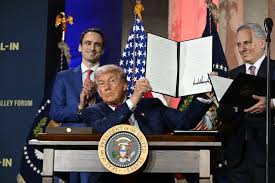
On December 11, 2025, President Donald Trump signed an executive order designed to limit the ability of U.S. states to regulate artificial intelligence (AI), saying a patchwork of state laws would stifle innovation and undermine U.S. competitiveness in the global AI race. (euronews)
Major outlets such as The Guardian, CNN, NBC, WLWT, and Euronews rushed to cover the announcement, highlighting its immediate political impact and how it will affect AI governance. However, several critical angles and implications were under-reported — particularly the legal limits of executive orders, consumer protection gaps, constitutional questions, and how the order could actually weaken rather than strengthen U.S. leadership.
Below, we analyze the key reporting, identify shortcomings in mainstream coverage, and provide a more complete narrative.
1. What the Order Actually Says
The executive order, titled “Ensuring a National Policy Framework for Artificial Intelligence,” explicitly seeks to preempt and block state AI laws that the administration says are “burdensome” or contradictory to a unified federal approach. It:
- Directs the Attorney General to form an “AI Litigation Task Force” to legally challenge state laws deemed inconsistent with federal AI policy. (The White House)
- Requires the Commerce Department to evaluate existing state AI laws and compile a list of “problematic” rules. (MarketBeat)
- Authorizes withholding federal broadband and other grant funding from states with certain AI regulations. (Reuters)
- Encourages Congress to craft a uniform national AI law that would preempt conflicting state laws. (The White House)
The White House justifies the move by saying state-level fragmentation could slow innovation and harm U.S. companies competing with China’s centralized regulatory model. (euronews)
Main stories correctly reported this broad outline, yet they missed several deeper issues that matter for legal authority, safety, and rights.
2. Why the Order Lacks Legal Force as a Law
Most news coverage notes — but doesn’t fully emphasize — that an executive order is not a federal statute passed by Congress. That means:
⚖️ Executive Orders Cannot Unilaterally Override State Law
The U.S. Constitution generally reserves to states the power to regulate health, safety, commerce, and consumer protections unless Congress acts. Major news articles mention this but often bury it deep in text. (The Guardian)
Legal analysts point out that:
- Federal executive orders cannot themselves nullify state laws simply by declaring they are “inconsistent.” States do not have to comply without clear Congressional preemption language.
- Attempts to use funding penalties to coerce state behavior could face Supreme Court limits on conditional grants under cases like NFIB v. Sebelius.
What most headlines miss: The executive order may be unconstitutional or legally ineffective unless Congress acts. The White House’s aggressive claims about blocking state laws on AI face real judicial risk that could defuse the order’s impact entirely.
3. Consumer Protection and Public Safety Left Out
Most major articles discuss the political dynamics — but very few cover the potential public safety consequences.
State AI laws — especially in California and Colorado — include provisions such as:
- Safety disclosures for new AI systems to protect consumers.
- Algorithmic discrimination protections in hiring and lending.
- Limits on deepfakes in elections and non-consensual content. (WSLS)
These provisions are crucial for civil rights, fairness, transparency, and personal safety. Yet the executive order appears focused on deregulation, not on replacing these protections.
Gap in coverage: None of the mainstream reports provide sufficient analysis of how stripping state authority could leave citizens vulnerable to AI harms in everyday life — from employment discrimination to privacy breaches.
4. Bias Toward Tech Industry Interests
Mainstream reporting often mentions Silicon Valley’s support for a national AI standard, but few examine how much industry involvement shaped the order.
High-level tech executives and lobbyists argued for a uniform federal regime, emphasizing:
- Reduced compliance costs.
- Fewer regulatory hurdles for startups and large AI firms.
Yet this benefits corporations far more than consumers, and may push innovation over safety — a trade-off journalists should have explored more deeply.
Missing angle: What are the economic incentives for tech giants? How did lobbying influence policy language? These questions go beyond surface reporting.
5. Constitutional Questions: The 10th Amendment
One of the most under-reported concerns is constitutional:
The Tenth Amendment reserves powers not delegated to the federal government to the states or the people.
By trying to preempt state AI laws without new Congressional authority, the executive order could violate states’ rights under the Constitution.
Most outlets only briefly mention this, if at all. A robust piece should examine how legal scholars have flagged potential overreach.
6. Bipartisan Opposition
While some articles note Republican pushback, few explain that opposition comes from both sides of the aisle:
- Some conservative leaders argue the order contradicts states’ rights principles.
- Some Democratic lawmakers support state-level consumer protections and fear unchecked AI harms.
This bipartisan resistance suggests the order could trigger not just legal challenges but political backlash that reshapes future AI legislation.
7. The Global Context: Innovation vs Safety
International competition with China’s AI strategy is often cited as justification. What many articles don’t fully explore is the broader context:
- China’s regulatory model is centralized but also highly restrictive, with robust controls on content and data flows.
- The U.S. argument for a single framework assumes less regulation is inherently better, but that’s a contested premise among AI ethics experts and economists.
Effective AI governance needs to balance innovation, safety, privacy, equity, and competitiveness — an analysis missing from most headlines.
8. What Comes Next: Courts, Congress, and States
Many reports conclude the executive order marked a significant policy shift. But what happens next is equally important:
🧑⚖️ Legal Challenges Likely
Based on constitutional limits, states like California and Colorado are expected to challenge the order in federal court.
🏛️ Congress May Act
With Republicans controlling the White House but not a consistent majority for AI legislation, Congress may be pressured to draft a true federal AI statute that balances national standards with safety protections.
🏙️ States Continue Innovation
Even with attempts to preempt state laws, some state governments could find ways to enforce rules through court decisions or alternative regulatory frameworks.
9. A More Complete Narrative
Here’s a summary that fills gaps left by many mainstream articles:
- The executive order seeks a unified federal AI framework but lacks clear legal authority to override states.
- It risks undermining consumer protections enshrined in state AI laws.
- Industry interests likely shaped the policy more than public safety concerns.
- There are significant constitutional questions about federal power limits.
- The move may provoke legal and political pushback that reshapes the future of AI regulation.
Conclusion: More Than a Headlines Story
Trump’s executive order on AI regulation is not just another political headline — it is a potentially transformative policy moment, with deep implications for how AI is governed in the U.S. In a field as consequential as artificial intelligence, simplistic coverage of “innovation vs regulation” falls short.
