
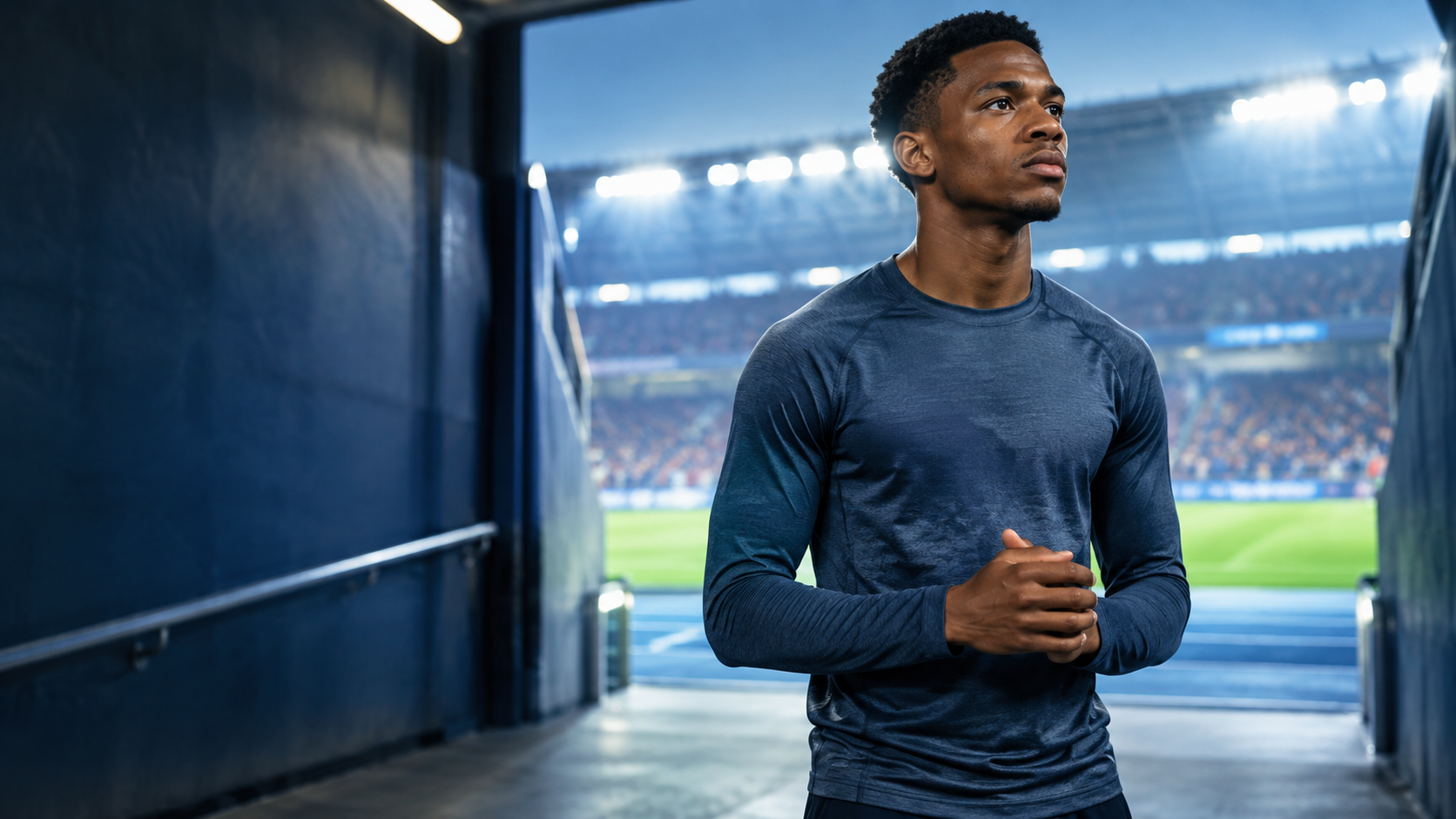
Feeling nervous before a game or competition is normal. You may notice sweaty palms, a racing heart, butterflies in your stomach, tense muscles, or thoughts that seem impossible to slow down.
Whether you’re preparing for a football match, basketball game, tennis match, swimming competition, running event, golf tournament, martial arts competition, or another sporting event, pre-game nervousness does not mean you’re unprepared or incapable of performing well.
The goal isn’t necessarily to eliminate nervousness completely. Instead, you want to learn how to control nervousness before a game or competition so you can use your energy effectively, stay focused, and perform the skills you’ve practiced.
The most useful strategies include controlled breathing, a consistent pre-game routine, visualization, constructive self-talk, process-focused goals, proper preparation, and learning how to recover quickly from mistakes.
Why Do You Get Nervous Before a Game or Competition?
Competition creates a situation where something matters to you and the outcome isn’t completely under your control.
Your brain may interpret the upcoming event as a challenge or threat. This can activate your body’s stress response, increasing alertness and preparing you for physical action.
You may experience:
- A faster heartbeat
- Faster or shallower breathing
- Sweaty palms
- Muscle tension
- Butterflies or discomfort in your stomach
- Shaking
- Dry mouth
- Racing thoughts
- Difficulty concentrating
- A strong urge to avoid the competition
- Fear of making mistakes
- Worry about what other people will think
These reactions are not necessarily signs that something is wrong.
In fact, some level of physical and mental activation can help you feel alert and ready to compete. The problem is when nervousness becomes so intense that it interferes with concentration, decision-making, technique, or enjoyment.
That’s why the goal is not:
“I must stop feeling nervous.”
A more useful goal is:
“I can feel nervous and still perform well.”
That change in perspective can make competition nerves easier to manage.
10 Ways to Control Nervousness Before a Game or Competition
1. Control Your Breathing
One of the simplest things you can control when you’re nervous is your breathing.
When anxiety increases, people often breathe faster or more shallowly. Deliberately slowing your breathing can give you something concrete to focus on while helping you settle physically.
Try this before your competition:
- Relax your shoulders and jaw.
- Breathe in gently through your nose.
- Exhale slowly and comfortably.
- Continue for one to two minutes.
- Keep your attention on the feeling of your breathing.
You can experiment with a slightly longer exhale than inhale—for example, breathing in comfortably and taking a slower six-second exhale.
Don’t force huge breaths or hold your breath for long periods. The goal is comfortable, controlled breathing, not maximum lung capacity.
Practice breathing during training
Don’t wait until five minutes before an important competition to try a breathing technique for the first time.
Practice it during training, after difficult drills, and before lower-pressure competitions. Then it becomes a familiar tool you can use when the pressure increases.
2. Create a Consistent Pre-Game Routine
Uncertainty can make nervousness worse.
A consistent pre-game routine gives you a sequence of familiar actions to follow instead of leaving your mind free to constantly think about the outcome.
Your routine might include:
- Arriving at the venue
- Checking your equipment
- Hydrating
- Eating your usual pre-game meal or snack
- Changing
- Warming up
- Practicing sport-specific movements
- Breathing for a few minutes
- Reviewing your game plan
- Using a short performance cue
- Listening to music
Your routine doesn’t need to be complicated.
For example:
Arrive → prepare equipment → warm up → breathe → review one goal → compete.
The purpose isn’t to create a superstition that must be followed perfectly. It’s to create a familiar structure that keeps your attention on preparation.
3. Focus on What You Can Control
One of the biggest causes of pre-game anxiety is spending too much mental energy on things you cannot control.
You cannot completely control:
- Your opponent
- The referee
- The crowd
- The weather
- Other competitors
- Whether you make every attempt
- The final score
- Other people’s expectations
But you can control:
- Your preparation
- Your effort
- Your attention
- Your warm-up
- Your communication
- Your breathing
- Your decision-making
- Your response to mistakes
- Whether you follow your game plan
When you notice yourself worrying about the outcome, ask:
“What can I control right now?”
Then direct your attention toward that action.
This doesn’t guarantee a particular result. It simply puts your attention where it can actually be useful.
4. Replace Outcome Goals With Process Goals
Before an important competition, it’s easy to think:
“I have to win.”
Or:
“I cannot make a mistake.”
These thoughts can create unnecessary pressure because winning and avoiding every mistake are not completely within your control.
Instead, choose one or two process goals.
For example:
Instead of:
“I have to win.”
Try:
“I will stay composed and follow my game plan.”
Instead of:
“I can’t make a mistake.”
Try:
“I will reset quickly after mistakes.”
Instead of:
“I need to score immediately.”
Try:
“I will focus on executing the first play correctly.”
Process goals tell your brain what to do rather than what outcome it must produce.
5. Use Short, Constructive Self-Talk
Your internal dialogue can either keep your attention on the task or increase your anxiety.
When you’re nervous, you may automatically think:
- “What if I fail?”
- “I can’t mess this up.”
- “Everyone is watching me.”
- “I’m not ready.”
- “My opponent is better than me.”
You don’t need to replace these thoughts with exaggerated statements such as “I’m definitely going to win.”
Instead, use short and believable performance cues.
Examples include:
- “One play at a time.”
- “Breathe and focus.”
- “Trust my preparation.”
- “Stay relaxed.”
- “Next point.”
- “Watch the ball.”
- “Keep moving.”
- “Commit to the shot.”
- “Reset and go again.”
The best cue depends on your sport and position.
A tennis player might use:
“Next point.”
A football player might use:
“Scan and move.”
A golfer might use:
“Smooth swing.”
The purpose is to direct your attention toward the action you want to perform.
6. Visualize Yourself Handling the Competition
Visualization, sometimes called mental imagery, can help you mentally rehearse important situations before they happen.
Instead of simply imagining yourself standing on a podium or seeing the final score, visualize the process of competing.
For example, imagine yourself:
- Walking onto the field or court
- Standing at the starting line
- Beginning your warm-up
- Executing an important technique
- Staying composed when the pressure increases
- Recovering after a mistake
- Following your game plan
- Finishing the competition with controlled effort
Make the visualization as realistic as possible.
You can imagine the environment, sounds, movements, and sensations associated with your sport.
Most importantly, visualize yourself handling challenges, not only having a perfect performance.
For example:
“I miss the shot, take a breath, reset, and focus on the next play.”
This prepares you psychologically for the reality that competition will not always go perfectly.
7. Have a Plan for Mistakes Before the Game Starts
Fear of making a mistake can be a major source of nervousness.
The problem is that trying to guarantee that you won’t make mistakes can make you even more focused on mistakes.
Instead, decide beforehand how you will respond when something goes wrong.
Use a simple reset process:
Recognize → Breathe → Reset → Act
Recognize
Acknowledge what happened without turning it into a judgment about yourself.
Breathe
Take one controlled breath.
Reset
Use a short cue such as:
“Next play.”
Act
Immediately focus on the next task.
For example, a basketball player misses a shot.
Instead of thinking:
“I’m playing terribly.”
The athlete can think:
“Missed it. Reset. Get back on defense.”
The mistake remains a mistake, but it doesn’t have to become several mistakes because of continued overthinking.
8. Prepare Your Body and Your Environment
Mental preparation is only one part of competition readiness.
Physical and logistical preparation can also reduce unnecessary stress.
Before competition, consider:
- Getting adequate sleep
- Eating foods you are accustomed to eating
- Staying appropriately hydrated
- Preparing your equipment
- Checking the competition schedule
- Planning transportation
- Knowing where you need to report
- Allowing enough time to warm up
- Wearing appropriate equipment or clothing
Avoid making major changes to your routine immediately before an important event.
Competition day is usually not the ideal time to experiment with a new supplement, unfamiliar food, unusually large amounts of caffeine, or a completely different warm-up.
If you use caffeine, understand how your body responds to it during training rather than experimenting with a large dose immediately before competition.
9. Practice Performing Under Pressure
If you only practice when you’re completely relaxed, competition can feel like a completely different environment.
You can sometimes introduce manageable pressure into training.
Depending on your sport, this could include:
- Keeping score
- Using time limits
- Practicing in front of teammates
- Simulating competition conditions
- Recreating your pre-game routine
- Practicing important situations repeatedly
- Performing skills when mildly fatigued, where appropriate
- Practicing recovery after mistakes
The purpose isn’t to make every training session stressful.
Instead, occasional pressure practice helps you learn that you can still perform while experiencing nervousness.
That’s an important mental skill.
10. Train Your Mental Skills Regularly
Mental preparation works best when it is part of training rather than something you suddenly try on competition day.
You can regularly practice:
- Controlled breathing
- Visualization
- Self-talk
- Attention control
- Goal setting
- Mistake recovery
- Pre-performance routines
- Pressure simulations
Think of these skills in the same way you think about physical or technical skills.
You wouldn’t expect to master a complicated technique by practicing it once before a major competition.
Mental skills benefit from repetition too.
A 10-Minute Routine to Calm Nerves Before a Game
If you need something simple to use immediately before competition, try this routine.
10–8 Minutes: Get Organized
Check your equipment and make sure you have everything you need.
Avoid unnecessary last-minute rushing.
8–6 Minutes: Slow Your Breathing
Take several comfortable breaths with a relaxed, controlled exhale.
Let your shoulders and jaw loosen.
6–4 Minutes: Visualize
Picture yourself performing two or three important actions effectively.
Include realistic challenges and imagine yourself responding calmly.
4–2 Minutes: Choose Your Focus
Pick one or two process goals.
For example:
- “Stay composed.”
- “Communicate.”
- “Watch the ball.”
- “Follow the game plan.”
- “One play at a time.”
2–0 Minutes: Focus on the First Action
Stop trying to mentally play the entire competition before it starts.
Ask:
“What do I need to do first?”
Then focus on that.
What to Do if You Are Still Nervous Right Before the Start
Sometimes you can prepare properly and still feel extremely nervous.
That’s normal.
Don’t make the additional mistake of becoming nervous about being nervous.
Instead, acknowledge the sensation:
“I’m feeling nervous because this competition matters to me.”
Then shift your attention toward action.
Try:
Breathe → Notice → Focus → Act.
You don’t need to wait until your heart rate feels completely normal.
You can compete while nervous.
You can perform while nervous.
You can make good decisions while nervous.
The ability to perform despite nervousness is an important part of becoming more comfortable under competitive pressure.
What to Do With Nervousness During the Game or Competition
Pre-game preparation isn’t the only time nerves matter.
You may suddenly become nervous after:
- Making a mistake
- Falling behind
- Entering the final minutes
- Facing an important opponent
- Hearing the crowd
- Taking a decisive shot
- Approaching the finish
- Reaching match point
- Taking a penalty or free throw
When that happens, return to your basic process.
1. Breathe
Take one controlled breath.
2. Narrow your focus
Don’t think about the entire competition.
Focus on the next action.
3. Use your cue
Say your short performance phrase.
4. Execute
Perform the skill you have practiced.
5. Reset
Whatever happened is now in the past.
Return your attention to what comes next.
What Not to Do When You’re Nervous Before a Game
Some reactions can make nervousness worse.
Try to avoid:
Constantly thinking about the final result
Repeatedly imagining whether you’ll win or lose gives you little useful information.
Comparing yourself with every opponent
You cannot accurately judge another athlete’s preparation simply by looking at them.
Changing everything at the last minute
A major change to your equipment, nutrition, warm-up, or strategy can create additional uncertainty.
Overusing caffeine
Large amounts of caffeine can make some people feel more restless, shaky, or physically activated.
Staying up late because you’re anxious
Preparation matters, but staying awake worrying about the competition usually isn’t productive.
Trying to force yourself to feel perfectly calm
The expectation that you must feel calm can create another source of pressure.
Replaying previous mistakes
You can learn from past performances, but immediately before competition your attention is usually more useful when directed toward the next action.
How to Turn Nervousness Into Useful Energy
You don’t necessarily need to interpret nervousness as a sign that you’re going to perform badly.
Consider the physical sensations you’re experiencing:
- Faster heartbeat
- Increased alertness
- More energy
- Heightened attention
- Muscle activation
These sensations can occur when you’re excited as well as when you’re afraid.
Instead of asking:
“Why am I so nervous?”
try asking:
“How can I use this energy?”
You might channel it into:
- A sharper warm-up
- Better communication
- More focused attention
- Stronger movement
- Greater awareness
- Commitment to your first action
The goal isn’t to convince yourself that everything will go perfectly.
It’s to recognize that nervous energy can coexist with effective performance.
How to Build Confidence Before Competitions
Confidence doesn’t have to mean believing you’ll always win.
A more useful form of confidence can come from trusting your preparation and knowing how you’ll respond when things don’t go according to plan.
You can build that confidence by:
- Practicing consistently
- Tracking your progress
- Reviewing performances
- Learning from mistakes
- Practicing under pressure
- Developing a reliable routine
- Setting realistic process goals
- Improving technical skills
- Improving physical preparation
- Practicing mental skills
After a competition, ask yourself:
What did I do well?
What can I improve?
What did I learn?
What will I practice next?
This turns competition into a learning experience rather than simply a judgment of whether you won or lost.
A Simple Pre-Competition Checklist
Use this checklist before your next game or competition.
Physical preparation
- Get adequate sleep
- Eat familiar foods
- Hydrate appropriately
- Prepare your equipment
- Complete your normal warm-up
Mental preparation
- Accept that some nervousness is normal
- Practice controlled breathing
- Visualize key actions
- Choose one or two process goals
- Prepare a short performance cue
- Decide how you will respond to mistakes
Competition focus
- Focus on what you can control
- Avoid obsessing over the final result
- Avoid unnecessary comparisons
- Focus on the next action
- Reset quickly after mistakes
Frequently Asked Questions About Controlling Nervousness Before a Game
How can I calm my nerves before a game?
Start with controlled breathing, then follow a familiar pre-game routine. Focus on one or two process goals rather than the final result, and use a short performance cue such as “one play at a time” or “breathe and focus.”
You don’t have to eliminate nervousness completely. The goal is to become able to perform while managing it.
Why do I get so nervous before competitions?
Competition can activate your body’s stress response because the event matters to you and the outcome contains uncertainty. Expectations, fear of failure, previous experiences, and pressure from yourself or others can also contribute to nervousness.
Is it normal to be nervous before a game?
Yes. Many athletes experience some level of nervousness before competition. Feeling nervous does not automatically mean that you will perform badly.
How do I stop shaking before a competition?
Try reducing unnecessary physical tension, slowing your breathing, and following your normal warm-up. Avoid interpreting shaking as proof that you cannot perform. If shaking is severe or frequently interferes with participation, consider discussing it with a qualified healthcare or mental-health professional.
What should I think about before a game?
Focus on your preparation, your process goals, and your first actions. Instead of repeatedly thinking about whether you’ll win or lose, ask yourself:
“What do I need to do next?”
How do athletes deal with pre-game anxiety?
Common approaches include preparation, consistent routines, breathing exercises, visualization, constructive self-talk, process goals, pressure practice, and learning how to reset after mistakes.
Can nervousness actually help performance?
Some level of physical and mental activation can be useful because it can increase alertness and energy. However, too much activation can interfere with concentration and execution. The useful objective is not necessarily zero nervousness but finding ways to manage your level of activation.
How long should I breathe to calm down before a game?
Even one or two minutes of comfortable, controlled breathing can give you an opportunity to settle your attention. Practice the technique during training so it becomes familiar before competition.
Should I listen to music before a competition?
If music helps you establish your routine or focus, it can be useful. Choose something that produces the state you want rather than automatically choosing the most energetic music.
What if I’m still nervous when the competition starts?
You don’t have to wait until you feel completely calm. Take a breath, focus on your first task, use your performance cue, and begin. The ability to perform while experiencing some nervousness is itself a skill that improves with practice.
When Should You Seek Professional Help for Competition Anxiety?
Normal pre-game nerves are different from anxiety that consistently becomes overwhelming or interferes with your life.
Consider speaking with a qualified mental-health professional, sports psychologist, physician, or other appropriate healthcare professional if anxiety:
- Regularly prevents you from competing
- Causes severe or persistent distress
- Interferes with sleep or daily activities
- Leads you to avoid sports you otherwise want to participate in
- Produces symptoms that concern you
- Continues well beyond competition situations
A professional can help determine what is contributing to the problem and identify appropriate strategies for managing it.
Final Takeaway: How to Control Nervousness Before a Game or Competition
Learning how to control nervousness before a game or competition isn’t about becoming completely fearless.
It’s about learning how to manage your body’s response, direct your attention, and continue performing when pressure is present.
Before your next competition:
Prepare → Breathe → Focus → Execute → Reset.
Prepare your body and equipment.
Use controlled breathing.
Focus on what you can control.
Use process goals and short performance cues.
Visualize yourself handling pressure.
Have a plan for mistakes.
Then focus on the next action rather than trying to predict the entire competition.
You may still feel butterflies in your stomach or notice your heart beating faster.
That’s okay.
Being nervous and being ready can happen at the same time.
