
If you’re new to pickleball, one of the most confusing parts of the game is where you’re supposed to stand on the court. You may hit decent shots, but still lose points simply because you’re out of position.
This guide breaks down pickleball court positioning for beginners in the clearest way possible. You’ll learn where to stand, how to move with your partner, and how good positioning can instantly improve your game—without hitting harder or faster.
Why Court Positioning Matters in Pickleball
Pickleball is not just about shot-making. It’s about angles, court coverage, and being in the right place before the ball arrives.
Good positioning helps you:
- Reach more balls with less effort
- Take away opponents’ angles
- Avoid easy pop-ups
- Win longer rallies consistently
Bad positioning does the opposite—even if your strokes are solid.
The Basic Pickleball Ready Position
Before talking about where to stand, you need the pickleball ready position, which applies everywhere on the court.
Beginner-ready position checklist:
- Feet slightly wider than shoulder-width
- Knees bent
- Weight on the balls of your feet
- Paddle up and in front
- Chest leaning slightly forward
This stance lets you react quickly whether the ball comes fast, slow, or at an awkward angle.
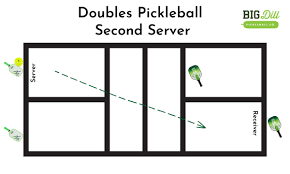
Where to Stand at the Start of a Point
Serving Team Positioning
- Server: Behind the baseline, diagonally aligned with the service box
- Server’s partner: Near the baseline, not at the kitchen line
This allows you to respect the double-bounce rule and prepare to move forward safely.
Receiving Team Positioning
- Receiver: Behind the baseline
- Receiver’s partner: Near the kitchen line (NVZ line)
This is one of the biggest beginner pickleball strategy advantages and gives your team early net control.
Pickleball Positioning After the Serve
One of the most common beginner mistakes is getting stuck in the middle of the court.
Correct pickleball positioning after serve:
- Stay back for the return
- Move forward only after the ball bounces
- Advance toward the kitchen together
The middle of the court is a danger zone. Opponents can easily attack balls that sit up there.
The Kitchen Line: The Most Important Spot on the Court
The kitchen line (Non-Volley Zone line) is where most points are won and lost.
Proper pickleball kitchen line positioning:
- Stand just behind the NVZ line
- Paddle up, ready for dinks and volleys
- Avoid stepping into the kitchen unless the ball bounces
When both partners reach the kitchen line together, you control angles and force opponents into mistakes.
Pickleball Doubles Positioning (Beginner Breakdown)
The “Move Together” Rule
In doubles, you and your partner should move as a unit, not independently.
If one player moves forward, sideways, or backward, the partner mirrors that movement.
Covering the Court Correctly
A beginner-friendly way to understand pickleball court coverage is to imagine the court split into three vertical lanes:
- Left lane
- Middle lane
- Right lane
The middle is the most important. Most points are won by controlling or attacking it.
Who Covers What?
- If the ball is hit toward your side → you protect the sideline
- If the ball is hit crosscourt → you protect the middle
This reduces confusion and prevents both players from chasing the same ball.
The “X” Movement Principle (Simplified)
Instead of following your partner, follow the ball.
- Ball goes right → both players shift right
- Ball goes left → both players shift left
This creates proper spacing and removes open gaps.
Pickleball Third Shot Positioning
After the serve and return, the serving team usually hits a third shot drop or drive.
Beginner third shot positioning tips:
- Stay back while hitting the third shot
- Move forward after the shot, not during
- Advance together toward the kitchen
Rushing forward too early often leads to getting passed or jammed.
Pickleball Singles Positioning (Quick Guide)
Singles positioning is simpler but more physically demanding.
Key pickleball singles positioning rules:
- Recover toward the center after each shot
- Hit deep to keep your opponent back
- Move forward only when you force a weak return
Unlike doubles, you must cover the entire court—but smart positioning reduces how much you run.
Common Pickleball Positioning Mistakes Beginners Make
Avoid these errors and your game will improve immediately.
❌ Staying in No-Man’s Land
The mid-court area exposes you to attack shots.
Fix: Move all the way back or all the way up—never linger.
❌ Standing Too Far Apart in Doubles
Large gaps invite easy winners down the middle.
Fix: Stay within one step of your partner laterally.
❌ Not Moving After the Shot
Hitting the ball and admiring it is a recipe for losing points.
Fix: Hit, recover, reset.
❌ Camping in the Kitchen
Standing inside the NVZ without a bounce leads to faults.
Fix: Hover just behind the line unless the ball bounces.
Beginner Pickleball Strategy: Simple Positioning Rules to Remember
If you remember nothing else, remember these:
- Get to the kitchen line as soon as possible
- Move with your partner, not independently
- Protect the middle first
- Avoid the middle of the court
- Stay balanced and ready
These five rules alone will put you ahead of most beginners.
Final Thoughts: Position Beats Power
You don’t need fancy shots or extreme athleticism to improve quickly in pickleball. Smart court positioning gives you more time, better angles, and fewer errors.
By mastering pickleball court positioning for beginners, you’ll:
- Win more points
- Feel less rushed
- Play with confidence
- Improve faster than expected
Position first. Power later.
