
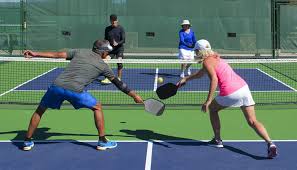
If you’re new to pickleball doubles, strategy can feel confusing. Who covers the middle? When should you move to the kitchen line? Why do better teams seem to win points without hitting hard?
The good news is this: pickleball doubles strategy for beginners is simple once you understand positioning, teamwork, and shot selection. You don’t need power or fancy shots—just smart decisions.
This guide breaks everything down step by step so you can start winning more games immediately.
1. The Golden Rule of Pickleball Doubles
The team that controls the kitchen line usually wins the point.
The non-volley zone (NVZ), commonly called the kitchen, is the most important area of the court. Teams that reach the kitchen line together:
- Take the ball earlier
- Hit sharper angles
- Force opponents into mistakes
Your entire strategy should revolve around getting to the kitchen safely and staying there.
2. Basic Pickleball Doubles Positioning
One of the most common beginner mistakes is poor positioning.
Correct doubles positioning:
- Both players should be side by side
- Avoid standing with one player up and one back
- Move together like you’re connected by a rope
This concept—often called “move as a team in pickleball”—prevents open spaces and makes defense easier.
📌 Rule of thumb:
If your partner moves forward, you move forward.
If your partner moves back, you move back.
3. Who Covers the Middle in Pickleball Doubles?
This is one of the most searched beginner questions—and for good reason.
Simple beginner rule:
- Forehands take priority over backhands
- The player with the stronger forehand usually covers more middle balls
In right-handed teams:
- The left-side player often takes the middle because their forehand is in the center
However, communication matters more than rules.
Use clear calls like:
- “Mine!”
- “Yours!”
- “Switch!”
Good pickleball doubles communication eliminates confusion and prevents free points for your opponents.
4. Getting to the Kitchen Line Safely
Beginners often rush the net and get punished. Instead, use smart shots.
Serve strategy:
- Serve deep to push opponents back
- A deep serve gives you time to move forward
Return strategy:
- Return deep and high
- Then move forward immediately
The return team has an advantage because they can approach the kitchen while the serving team must hit a third shot.
5. The Third Shot Drop Strategy (Beginner-Friendly)
The third shot drop is one of the most important pickleball doubles tactics.
What it is:
A soft shot hit from the baseline that lands gently in the opponent’s kitchen.
Why it works:
- Prevents opponents from smashing the ball
- Gives you time to move forward
- Resets the rally in your favor
Beginner tip:
You don’t need perfection. Aim high over the net and let gravity do the work.
If the drop is too difficult, a third-shot drive followed by a drop is a solid alternative.
6. Pickleball Kitchen Line Strategy for Beginners
Once both teams reach the kitchen, the real chess match begins.
Key kitchen principles:
- Keep your paddle up
- Stay balanced
- Avoid hitting the ball too hard
Dinking basics:
Dinking is a soft shot that lands in the kitchen and forces opponents to hit upward.
Best beginner target:
👉 Opponent’s backhand
Consistent dinking wins far more points than power at this level.
7. Pickleball Doubles Roles: Right Side vs Left Side
Understanding roles simplifies decision-making.
Right-side player (even side):
- Often handles more dinks
- Plays a steadier, patient role
- Sets up points
Left-side player (odd side):
- More aggressive
- Attacks pop-ups
- Covers more middle balls
At the beginner level, these roles are flexible—but knowing them helps with positioning and confidence.
8. Common Pickleball Doubles Mistakes Beginners Make
Avoid these and your win rate will jump immediately.
❌ Mistake 1: Staying at the baseline too long
Move forward after your return or drop.
❌ Mistake 2: Hitting everything hard
Soft shots win more points in doubles.
❌ Mistake 3: Poor communication
Silence causes confusion—talk to your partner.
❌ Mistake 4: Standing too close to the kitchen line
Give yourself a step of space to handle fast shots.
9. Simple Doubles Tactics That Work at Beginner Level
You don’t need advanced patterns. Focus on these:
- Hit to the middle to cause confusion
- Aim at opponents’ feet
- Target the weaker player
- Be patient—let mistakes happen
Pickleball rewards consistency far more than risk.
10. How to Improve as a Beginner Doubles Team
Progress comes faster when you practice smart.
Best ways to improve:
- Drill dinks for 10 minutes per session
- Practice third shot drops together
- Play with the same partner consistently
- Watch your positioning between points
The goal isn’t winning every rally—it’s building habits that scale as you improve.
Final Thoughts
Mastering pickleball doubles strategy for beginners isn’t about power or speed. It’s about:
- Smart positioning
- Reaching the kitchen together
- Communicating clearly
- Choosing consistency over flash
If you apply just a few of these tactics, you’ll notice fewer errors, longer rallies, and more wins—fast.
