
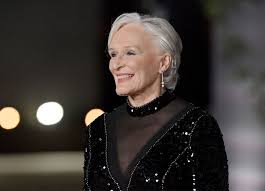
1. Early Life & Formative Years: A Complex Childhood
Glenn Close was born March 19, 1947, in Greenwich, Connecticut, to Elizabeth “Bettine” (née Moore) and William Taliaferro Close, an influential surgeon who worked in Africa. (Wikipedia)
Her family’s unusual upbringing involved long stretches abroad. Close’s early years were marked by a mix of affluence, global travel, and intense ideological living as her parents joined the Moral Re-Armament movement — a group she has later described as controlling and emotionally difficult. (AARP)
This combination of exposure to diverse cultures, emotional discipline, and imaginative play — performing puppet shows and games with her siblings — cemented a lifelong fascination with narrative and character. She later noted that these early experiences made acting seem “natural.” (Wikipedia)
After leaving Moral Re-Armament as a young adult, Close attended Choate Rosemary Hall and eventually the College of William & Mary, where she studied theater and anthropology. (Wikipedia)
2. Stage Beginnings & Rise to Prominence
Glenn Close began acting professionally on stage in 1974 at age 27, debuting in Love for Love. (Wikipedia)
Throughout the late 1970s and early 1980s, she performed in notable Broadway productions such as Barnum (1980) and The Real Thing (1983), earning critical respect and her first Tony Award for Best Actress in a Play. (Wikipedia)
Her theatre work combined classical training with emotional honesty, establishing her reputation long before most film audiences knew her name.
3. Breakthrough in Film: Versatility Defined
📌 Film Debut and Early Oscar Nods
Close’s film debut came in The World According to Garp (1982), alongside Robin Williams. She received an Academy Award nomination for Best Supporting Actress — rare for a first film role. (Wikipedia)
Her early film trajectory was remarkable:
- The Big Chill (1983) — ensemble drama that resonated with baby boomers. (Wikipedia)
- The Natural (1984) — further critical acclaim. (Wikipedia)
These roles helped Close become established in Hollywood as an actress with range and depth.
4. Iconic Era: Fatal Attraction & Dangerous Liaisons
In the late 1980s, her performances became cultural touchstones:
🎯 Fatal Attraction (1987)
As Alex Forrest, Close portrayed an obsessive woman whose intensity captured the zeitgeist of 1980s cinema. The role became iconic in portraying female agency and psychological complexity. (Wikipedia)
🎯 Dangerous Liaisons (1988)
Her portrayal of the Marquise de Merteuil — a scheming aristocrat — won her another Oscar nomination and cemented her versatility. (Wikipedia)
These roles challenged stereotypes of women in film and highlighted Close’s skill at transforming herself.
5. Television & Later Film Work
Beyond feature films, Close developed strong work in television:
- Serving in Silence: The Margarethe Cammermeyer Story (1995) — Emmy Award. (Wikipedia)
- Damages (2007–2012) — critically acclaimed legal drama, reaching new audiences. (Wikipedia & IMDb)
In the 2010s and 2020s, she continued picking challenging and varied roles, such as:
- Albert Nobbs — Oscar nomination for playing a butler striving for identity. (Wikipedia)
- The Wife — emotional powerhouse role earning Golden Globe recognition. (Encyclopedia Britannica)
- Hillbilly Elegy — critical discussion but significant acclaim for her performance. (Wikipedia)
Across decades, she has shown a rare ability to shift between blockbusters, indie dramas, and intimate television roles.
6. Personal Life & Relationships
While much of her professional life is public, Close’s personal life adds depth to her public image:
- Married three times — most recently to David Shaw (2006–2015). (Wikipedia)
- She has one daughter, Annie Starke, who has also pursued acting. (Wikipedia)
- Close lived with actor Len Cariou in the early 1980s. (Wikipedia)
Her relationships have been woven around creative collaboration and professional environments, reflecting a life deeply rooted in art and performance.
7. Activism, Advocacy & Philanthropy
One thing Wikipedia and IMDb list but don’t explore in depth is the scale of Close’s activism:
🔹 Women’s Rights & Social Causes
Close participated in pro-choice marches with Gloria Steinem and Jane Fonda and continues to advocate for gender equality. (Wikipedia)
🔹 LGBTQ+ Advocacy
She campaigned for same-sex marriage and earned a GLAAD Media Award for her support of equal rights. (Wikipedia)
🔹 Mental Health Awareness
Close openly shares her family’s experience with mental illness to reduce stigma. (Wikipedia)
🔹 Animal and Environmental Conservation
She serves on boards and supports wildlife initiatives. (Wikipedia)
This depth of philanthropic engagement reveals a complex public figure who uses her platform meaningfully, beyond acting roles.
8. End-of-Life Reflections & Legacy Planning
In recent personal revelations, Glenn Close shared intimate plans for the end of her life — a detail not reflected in Wikipedia or IMDb:
At age 78, she discussed building a replica of her childhood stone cottage — a place of deep personal significance — and expressed her intention to spend her final days there. (New York Post)
This emotional insight offers a rare humanizing glimpse into her personal world — a level of detail few biography pages explore.
9. Acting Style & Professional Legacy
While IMDb lists credits and Wikipedia lists roles, few sources unpack how Close works:
- Critics and peers praise her immersive technique — blending emotional truth with controlled craft. (Wikipedia)
- She trained with esteemed acting coaches and approaches each role with intellectual rigor. (Wikipedia)
Glenn Close’s legacy is one of bravura, range, and resilience, reflected in her long career and adaptability across media and genres.
10. Why Glenn Close Is a Cultural Touchstone
More than a sum of awards and roles, Glenn Close represents:
✔ Persistent excellence across film, television, and theater.
✔ A challenge to ageism and stereotype roles for women.
✔ A voice for activism and social engagement.
✔ An enduring presence for nearly 50 years. (Encyclopedia Britannica)
Her story resonates with audiences at emotional, intellectual, and cultural levels — the essence of a timeless artist.
