
Pickleball is one of the fastest-growing sports in the world, and one of the first questions new players ask is simple:
What’s the difference between indoor vs outdoor pickleball rules?
The short answer may surprise you: the core rules are the same.
However, the way the game is played can feel very different indoors versus outdoors.
In this beginner-friendly guide, we’ll clearly explain:
- Whether indoor and outdoor pickleball rules are the same
- The real differences beginners need to know
- How balls, courts, and environment change the game
- Which setup is better for learning pickleball
If you’re new to the sport, this article will give you clarity and confidence before stepping onto the court.
Are Indoor and Outdoor Pickleball Rules the Same?
Yes — indoor and outdoor pickleball rules are officially the same.
The rules defined by governing bodies apply equally to both environments, including:
- Scoring system (rally or traditional)
- Serving rules
- The non-volley zone (“the kitchen”)
- Faults and violations
- Double bounce rule
So when people talk about indoor vs outdoor pickleball rules, they are usually referring to equipment and playing conditions, not rule changes.
This misunderstanding is very common among beginners.
Difference Between Indoor and Outdoor Pickleball (At a Glance)
| Feature | Indoor Pickleball | Outdoor Pickleball |
|---|---|---|
| Rules | Same official rules | Same official rules |
| Ball | Softer, lighter | Harder, heavier |
| Holes | Fewer, larger holes | More, smaller holes |
| Court | Wood or gym floor | Concrete or asphalt |
| Environment | Controlled | Wind, sun, weather |
| Game Speed | Slower | Faster |
Now let’s break this down in detail.
Indoor vs Outdoor Pickleball Balls (Biggest Difference)
The pickleball itself creates the biggest difference in how the game feels.
Indoor Pickleball Balls
- Softer plastic
- Lighter weight
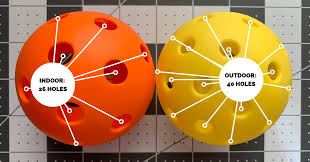
- Fewer, larger holes (usually 26)
- Lower bounce
- Slower flight
These balls are designed to:
- Reduce noise in gyms
- Provide more control
- Prevent excessive bounce on smooth floors
Outdoor Pickleball Balls
- Harder plastic
- Heavier
- More, smaller holes (usually 40)
- Higher bounce
- Faster flight
Outdoor balls are built to:
- Resist wind
- Withstand rough court surfaces
- Maintain consistent bounce outdoors
This pickleball ball hole difference is why switching environments can feel challenging at first.
Can You Use Outdoor Pickleballs Indoors?
Technically, yes — but it’s not recommended.
Using outdoor balls indoors often causes:
- Excessive bouncing
- Faster, harder shots
- More noise
- Reduced control for beginners
Most gyms and recreation centers require indoor balls only to protect flooring and reduce sound.
If you’re just learning, always match the ball to the environment.
Pickleball Court Differences: Indoor vs Outdoor
Indoor Courts
- Wood gym floors
- Rubberized or synthetic surfaces
- Smoother and more forgiving
- Consistent bounce
Outdoor Courts
- Concrete or asphalt
- Rougher texture
- Higher ball bounce
- Faster wear on balls and paddles
While court dimensions remain identical, the surface texture directly affects speed, bounce, and player movement.
Environmental Factors That Change the Game
Indoor Play
- No wind
- No sun glare
- Stable temperature
- Consistent lighting
This makes indoor pickleball ideal for:
- Beginners
- Skill development
- Controlled practice
Outdoor Play
- Wind affects ball flight
- Sun can limit visibility
- Temperature changes ball performance
- Weather can interrupt play
Outdoor pickleball rules don’t change, but players must adapt strategy constantly.
Indoor Pickleball Rules for Beginners (What Feels Different)
Although the rules stay the same, beginners often notice:
- Longer rallies
- More dink exchanges
- Slower pace
- Easier control
Indoor pickleball encourages:
- Soft shots
- Precision placement
- Net play development
This is why many coaches recommend indoor pickleball for beginners.
Outdoor Pickleball Rules Explained for New Players
Outdoor pickleball feels more aggressive because:
- The ball travels faster
- Spin has more effect
- Wind adds unpredictability
Beginners may struggle initially with:
- Timing
- Ball control
- Consistency
However, outdoor play builds:
- Reaction speed
- Shot power
- Tactical awareness
Indoor vs Outdoor Pickleball Strategy
Indoor Strategy
- Focus on dinks
- Control placement
- Patience wins points
- Longer rallies
Outdoor Strategy
- Adjust for wind direction
- Hit lower margin shots
- Use power selectively
- Expect faster points
Understanding indoor and outdoor pickleball strategy helps players transition smoothly between environments.
Indoor vs Outdoor Pickleball for Beginners: Which Is Better?
Indoor Is Better If You:
- Are brand new to pickleball
- Want slower play
- Prefer consistent conditions
- Are learning technique
Outdoor Is Better If You:
- Enjoy faster gameplay
- Like outdoor sports
- Want more challenge
- Are developing competitive skills
Many players enjoy both and switch depending on season and location.
Common Beginner Mistakes to Avoid
- Using outdoor balls indoors
- Ignoring wind outdoors
- Assuming rules are different
- Switching environments without adjustment time
- Overhitting indoor shots
Awareness alone can significantly improve your game.
Frequently Asked Questions
Do indoor and outdoor pickleball courts have the same size?
Yes. Court dimensions are identical regardless of location.
Are indoor pickleball rules different from outdoor?
No. Only equipment and environment differ.
Why does outdoor pickleball feel harder?
Wind, faster balls, and rough surfaces increase difficulty.
Final Thoughts
When it comes to indoor vs outdoor pickleball rules, the confusion is understandable — but the truth is simple:
👉 The rules stay the same. The game changes.
The ball, court surface, and environment dramatically affect how pickleball is played, especially for beginners.
If you’re new, start where you feel comfortable, use the correct equipment, and allow time to adjust when switching environments.
Pickleball is designed to be fun, social, and accessible — indoors or outdoors.
