
Introduction: Why the Kitchen Rule Confuses So Many Beginners
If you’re new to pickleball, the kitchen (non-volley zone) is probably the most confusing part of the game. Many beginners lose points not because of bad shots, but because they unknowingly break kitchen rules.
This guide offers Kitchen (Non-Volley Zone) rules explained in simple language. You’ll learn what the kitchen is, when you can step into it, when you can’t, and how to avoid common faults that frustrate new players.
By the end, you’ll understand the rules clearly—and play with confidence.
What Is the Kitchen (Non-Volley Zone) in Pickleball?
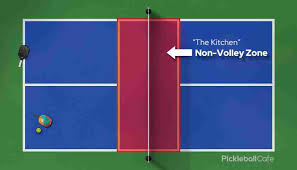
The kitchen, officially called the non-volley zone (NVZ), is a 7-foot area on both sides of the net.
Key facts beginners should know:
- The kitchen extends 7 feet from the net
- It includes the painted line
- You can stand inside it
- You just can’t volley the ball there
Understanding this zone is essential for learning proper pickleball kitchen rules for beginners.
Why Is It Called the Kitchen?
The nickname “kitchen” comes from old tennis slang meaning a restricted or dangerous area. While informal, the name stuck—and now everyone in pickleball uses it.
Official rulebooks still refer to it as the non-volley zone, but both terms mean the same thing.
The Most Important Rule: No Volleying in the Kitchen
Here’s the core rule beginners must remember:
You cannot hit the ball out of the air (volley) while touching the kitchen or the kitchen line.
This is the foundation of all non-volley zone rules explained.
What counts as “touching”?
- Your foot
- Your shoe
- Your clothing
- Your paddle
- Anything connected to you
If any of these touch the kitchen while volleying, it’s a fault.
Is the Kitchen Line In or Out?
One of the most common beginner questions is:
Is the kitchen line in pickleball?
Yes. The kitchen line is considered part of the kitchen.
That means:
- Stepping on the line while volleying = fault
- Touching the line with your shoe or paddle = fault
This rule applies fully under pickleball kitchen line rules, and it catches many beginners off guard.
Can You Step in the Kitchen After Hitting the Ball?
This depends on how you hit the ball.
If you hit a volley:
❌ You cannot step into the kitchen during or after the shot
❌ Momentum carrying you forward counts as a fault
This is known as the pickleball kitchen momentum rule.
If the ball bounces first:
✅ You can step into the kitchen
✅ You can stay there as long as you want
So when people ask, “can you step in the kitchen after hitting the ball?”
The correct answer is: only if the ball bounced first.
Understanding the Momentum Rule (Very Important)
Momentum is where many beginners lose points.
What is momentum?
If you volley the ball outside the kitchen, but your body keeps moving forward and you fall or step into the kitchen, it’s still a fault.
Even if:
- The shot was clean
- You didn’t mean to step forward
- The ball already crossed the net
Momentum violations are strictly enforced under pickleball NVZ rules.
When Can You Enter the Kitchen in Pickleball?
Despite the restrictions, the kitchen is not forbidden territory.
You can enter the kitchen when:
- The ball has bounced
- You’re retrieving a short dink
- You’re standing there waiting for a bounced ball
So, when can you enter the kitchen in pickleball?
Anytime—as long as you don’t volley.
Can You Reach Over the Kitchen to Hit a Volley?
Yes, and this surprises many beginners.
You may:
- Stand outside the kitchen
- Reach over the kitchen
- Hit a volley in the air
As long as:
- Your feet stay outside
- You don’t touch the kitchen
- Your momentum doesn’t carry you forward
This rule allows advanced net play while keeping the game fair.
Can Your Partner Be in the Kitchen?
Yes.
Your partner’s position does not affect your shot.
That means:
- Your partner can stand in the kitchen
- You can volley from outside
- No fault occurs unless you touch the kitchen
This detail is often misunderstood in pickleball non-volley zone examples.
Common Kitchen Faults Beginners Make
Understanding common kitchen faults in pickleball helps you avoid easy mistakes.
Most frequent beginner errors:
- Stepping on the kitchen line while volleying
- Falling forward after a volley
- Letting a paddle touch the kitchen
- Assuming the kitchen is completely off-limits
- Forgetting momentum still counts after contact
Avoiding these errors alone can significantly improve your game.
Simple Examples to Make It Clear
Example 1: Legal Play
You stand outside the kitchen.
You volley the ball.
You stop and remain balanced.
✅ Legal shot.
Example 2: Fault
You volley outside the kitchen.
Your foot slides onto the line.
❌ Fault due to momentum.
Example 3: Legal Kitchen Shot
The ball bounces in the kitchen.
You step in and hit it.
✅ Legal shot.
These pickleball non-volley zone examples help beginners visualize the rule.
Why the Kitchen Rule Exists
The kitchen rule:
- Prevents constant smashing at the net
- Encourages dinking and strategy
- Keeps rallies longer and fair
Without it, taller or stronger players would dominate easily.
Beginner Tips to Master Kitchen Rules Faster
- Practice stopping your momentum after volleys
- Watch your feet near the line
- Focus on dinking during net play
- Don’t rush volleys close to the kitchen
Mastering kitchen awareness is a key step in learning pickleball kitchen rules for beginners.
Frequently Asked Questions
Can I stand in the kitchen all the time?
Yes, as long as you don’t volley.
Can my paddle touch the kitchen?
Not while volleying. That would be a fault.
Is jumping allowed near the kitchen?
Yes—but you must land outside if you volleyed.
Final Thoughts: Master the Kitchen, Master the Game
Understanding Kitchen (Non-Volley Zone) rules explained properly is one of the fastest ways to improve as a beginner.
Once you know:
- When you can enter
- When you can volley
- How momentum works
You’ll stop giving away free points and start playing smarter pickleball.
The kitchen isn’t your enemy—it’s your strategic advantage when used correctly.
