
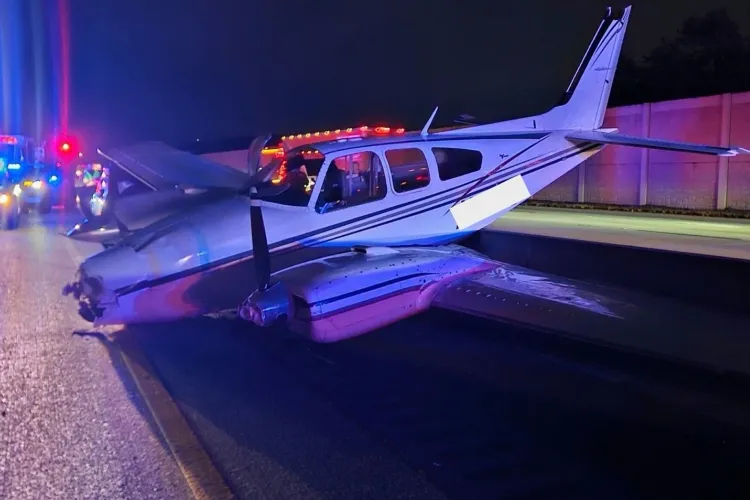
On the evening of December 8, 2025, during the rush-hour commute in Cocoa, Florida, something almost unthinkable happened: a small twin-engine aircraft descended out of the sky and crash-landed directly onto the southbound lanes of Interstate 95. It struck a Toyota Camry traveling in traffic, yet miraculously — for all the drama and damage — only one person was hospitalized, and no life was lost. (BNO News)
This was not just a shocking spectacle captured on dash-cam video — it was a near-disaster, a collision of airborne and ground-transportation regimes, and a moment that raises urgent questions about aviation safety, public risk, and regulatory accountability. But as widely shared as the video is, the media coverage so far remains shallow: fast, reactive, and missing important context. This article attempts to reconstruct what we know — and don’t yet know — and argues why this incident deserves deeper public scrutiny.
What We Know — The Established Facts
The Crash: What Happened
- A small twin-engine aircraft — identified by some sources as a Beechcraft 95‑C55 Baron (tail number N95KC) — made an emergency landing on the southbound lanes of I-95 near mile marker 201, just south of SR 520 in Cocoa, Brevard County, at approximately 5:45 p.m. local time. (AeroTime)
- The plane collided directly with a 2023 Toyota Camry, driven by a 57-year-old woman from Melbourne. (Spectrum News 13)
- On board the aircraft were two people: a 27-year-old pilot from Orlando and a 27-year-old passenger from Temple Terrace. Neither reportedly suffered injuries. (FOX 35 Orlando)
- The Camry driver was transported to Viera Hospital with “minor injuries.” Authorities have not publicly disclosed her name. (Spectrum News 13)
- Dash-cam footage, reportedly from a vehicle directly behind the Camry, captured the plane’s descent, the collision, and the immediate aftermath; the footage quickly went viral. (BNO News)
- Southbound lanes (and for a time, parts of northbound) of I-95 were closed while first responders, rescue crews, and investigators from the Federal Aviation Administration (FAA) and the Florida Highway Patrol (FHP) secured the scene, cleared wreckage, and began preliminary investigation. Traffic was reportedly heavily disrupted. (WESH)
- According to initial reports, the pilot had notified authorities of engine issues before the emergency landing attempt — prompting the decision to attempt a highway landing. (BNO News)
What We Don’t Know — Gaps in Media Coverage & Public Record
Despite many outlets reporting the crash and publishing the dramatic video, key information remains missing or unclear. These omissions matter — because without them, we cannot fully understand how and why this near-catastrophe occurred, or whether similar risks remain for unsuspecting motorists.
1. Aircraft & Flight Details Largely Omitted or Unconfirmed
- While some reports name the plane as a Beechcraft 95-C55 Baron (N95KC), not all outlets cite the model or tail number, and those that do provide no verifiable documentation. Without official FAA documentation, we lack confirmation. (Spagnoletti Law Firm)
- There is no publicly available maintenance history, ownership record, or last inspection data for the plane. We don’t know when it was built, how many hours it has flown, or when it last underwent a safety inspection.
- The reason for the engine issues remains vague. While “engine trouble” is cited, it is unclear whether this was due to mechanical failure, fuel exhaustion, maintenance neglect, pilot error, or environmental factors. No source has yet provided statements from maintenance logs, fuel records, or sensor data. In short: the root cause remains unknown.
2. Environmental & Traffic Conditions at Time of Crash Unreported
- None of the published articles describe the weather conditions at the time: visibility, wind, light levels, precipitation — all factors that matter significantly for emergency landing safety.
- There is no account of traffic density, speed, lane positions, or road conditions (e.g., whether the Camry was in the left, center, or right lane; how fast traffic was moving; whether there was congestion; whether other vehicles were in the immediate path). This omission severely limits our ability to understand whether the collision could have been avoided, or whether the pilot’s decision to land on the highway was particularly reckless or justified given context.
- No data on whether there were other vehicles near the Camry that were nearly hit — though one eyewitness claims the plane “just missed” his vehicle. (www.ndtv.com)
3. Lack of First-Person Accounts & Human Perspective
- The name, statements, or perspective of the Camry driver — the motorist directly affected — are nowhere to be found. No interview, no quotes; only “57-year-old woman, taken to hospital with minor injuries.” (Spectrum News 13)
- The occupants of the plane (pilot and passenger) remain unidentified publicly, and no statements from them have surfaced describing what happened: what they heard or saw, what decisions they made, or whether they considered other landing options.
- Few — if any — quotes from first-responders, emergency personnel, or other motorists beyond one or two named eyewitnesses. This leaves the story emotionally flat, devoid of human texture, and devoid of meaningful insight into the human impact beyond the terse “minor injuries” line.
4. No Regulatory or Safety Context
- None of the reports attempt to place this crash in a broader historical or statistical context: How common (or rare) are emergency landings on highways by small planes? How many such near-misses or collisions have occurred in recent years in Florida or the U.S.?
- There’s no discussion of regulatory protocols: under what circumstances is an emergency landing on a major interstate lawful or acceptable? What obligations does the pilot or aircraft owner have to avoid populated roads or highways? Are there rules or guidelines (FAA, FHP, state law) that govern such landings?
- There is no public pressure (yet) or visible demand for transparency: no calls from aviation-safety organizations, no mention of possible regulatory changes, oversight reviews, or even a plan for public release of investigation findings.
Why the Gaps Matter — Risk, Responsibility & Public Interest
These missing details are not just scholarly gaps. They represent critical public-interest deficits that, if left unaddressed, undermine our collective ability to learn, prevent, and hold institutions accountable. Here’s why:
🔥 Public Safety & Risk to Innocent Motorists
When a small plane attempts an emergency landing on a busy highway, it doesn’t just risk the lives of those on board — it puts every single motorist on that highway at risk. The dramatic video captures that risk only visually; without details (traffic density, vehicle positions, alternative landing spaces, timing), motorists and the public can’t assess how dangerous this was, or whether similar events could happen again.
Moreover, if the underlying cause was mechanical failure or maintenance negligence, then every small-plane flight — especially those that pass over or near highways — becomes a potential hazard for unsuspecting drivers.
📜 Accountability, Regulation & Oversight
Without public disclosure of the aircraft’s maintenance logs, ownership, inspection history, and pilot credentials, how can regulators, oversight bodies, or the public evaluate whether safety protocols were observed? The absence of such transparency denies citizens the basis to demand reform or to ensure that small-plane operators are held to high standards.
If this incident remains treated as a “rare freak accident,” there is no impetus for improved regulation, stricter maintenance requirements, or reconsideration of flight paths near highways. That’s a lost opportunity — and perhaps, a dangerous oversight.
🧑🤝🧑 Human Cost and Empathy
Behind the crash is a human story — a woman driving her car home, a pilot, a passenger. Yet media coverage strips away their identities, their voices, their trauma. Without their stories, readers — many of whom commute daily on highways — cannot connect emotionally to the reality that a plane could fall out of the sky above them.
That lack of human detail reduces the crash to a spectacle — viral video, shocking footage — but fails to provoke empathy, engagement, or demand for accountability.
📰 A Missed Opportunity for Meaningful Journalism
This crash could — and should — be more than a dramatic video and a short summary. It could — and should — spark deeper investigation: into aviation safety, highway risk, regulatory oversight, and public accountability. That requires more than just sharing dash-cam footage; it requires patience, follow-up, context, expert commentary, official statements, and data.
What a Robust, Definitive Article Should Include
If I were writing a follow-up investigative piece — one meant not just to shock, but to inform, explain, and demand accountability — this is what I would try to include:
- Aircraft data & history
- Model, tail number, registration, aircraft age, total flight hours.
- Ownership/ operator information (private owner, flight school, charter company, etc.).
- Maintenance history, last airworthiness inspection, maintenance logs, any prior reported issues, fuel logs.
- Pilot & passenger profile
- Pilot license status, flight hours, training history (solo, instructional, multi-engine certification).
- Whether this flight was private, instructional, a charter, or other.
- Statements from pilot/passenger (what they experienced, what they thought, whether they had alternatives, whether they attempted other landing sites) — if they consent.
- Investigation transparency
- Official statements from FAA and FHP or other investigating authorities.
- Whether flight data — if available — will be analysed; if there was a “black box” or recording instruments.
- Timeline for release of preliminary findings, and plan for public reporting.
- Environmental & traffic conditions at the time
- Weather data: visibility, wind, precipitation, light (sunset?).
- Traffic conditions: approximate speed, density, number of vehicles, lane positions, whether congestion or free-flow, presence of other vehicles near the Camry.
- Whether other vehicles were struck or narrowly avoided impact — and interviews from those motorists.
- Eyewitness and first-responder accounts
- Statements from other motorists (beyond the one or two already quoted), bystanders, firefighters, medics, tow-truck / recovery crews.
- Human interest: what the Camry driver remembers: whether she saw the plane, had time to react, what happened to the vehicle, emotional and physical aftermath.
- Photographs of damage, site, skid marks, vehicle positions, crash geometry, to allow partial reconstruction of trajectory.
- Contextual data and historical comparison
- Statistics on emergency landings by small aircraft on highways or public roads in Florida / U.S. over past 10–20 years.
- Outcomes: how many ended without damage/injury, how many resulted in collisions or fatalities.
- Past incidents in Florida (or elsewhere) and what caused them; whether maintenance, pilot error, weather, etc. identified.
- Regulatory / policy discussion
- Are there FAA regulations regarding emergency landings on public roads? Are there guidelines for small-plane operators to avoid highways / populated areas when possible?
- Should there be stricter maintenance, better tracking, mandated flight-path restrictions near major interstates?
- Should highway safety authorities work with aviation regulators to establish “no-fly zone” corridors near busy roads, or public warnings when small aircraft are in distress?
- Human impact & follow-up
- What happened to the Camry driver (medical, repair costs, insurance, legal issues).
- What happened to the plane occupants (trauma, insurance / liability, future flight privileges).
- Community reaction: did local residents demand more transparency, safer flight regulations, or call for policy changes?
- Expert opinions and risk assessment
- Aviation-safety experts: on how rare — or not — highway landings are, why they happen, and what can be done.
- Road-safety analysts: on risks to motorists, potential for future incidents.
- Policy / regulatory analysts: on what reforms could be considered to prevent recurrence.
- Narrative & storytelling — not just facts
- Use human stories, emotional weight, personal perspectives to make the article more than just a technical report.
- Use visuals: crash-site photos, diagrams, video stills, maps.
- Frame the event not as a freak accident but as a near-miss that reveals systemic risk and the need for scrutiny.
A Sample “Full Article” Draft (with placeholders for missing data)
Title: When Planes Fall onto Highways: The I-95 Crash That Could Have Been Catastrophe
Subtitle: A small Beechcraft Baron crash-landed on Florida’s busiest interstate during rush hour. Miraculously, only one person was seriously hurt — but the causes, the risks, and the oversight remain largely unknown.
By: [Your Name]
Date: [Today’s Date]
Lead
At approximately 5:45 p.m. on December 8, 2025, a small twin-engine plane — a Beechcraft 95-C55 Baron — descended suddenly from the sky and crash-landed onto southbound lanes of Interstate 95 near mile marker 201 in Cocoa, Florida. The aircraft struck a 2023 Toyota Camry traveling southbound during rush hour, shearing off its trunk, crushing its rear end, and sending sparks across the highway. On board the plane: a 27-year-old pilot and a 27-year-old passenger. In the car: a 57-year-old woman. By the time traffic-care crews arrived and cleared the wreckage — hours later — law-abiding commuters had had a close brush with disaster.
Yet, beyond the dramatic dash-cam footage and the overnight headlines, little is known. The cause of the crash remains publicly unconfirmed. Maintenance logs, pilot history, environmental conditions, and traffic data have not been released. The people involved remain unnamed and mostly silent. What happened, and what could have been, remains unfinished business.
The Known Facts
According to the Brevard County Fire Rescue (BCFR) and the Florida Highway Patrol (FHP), the Beechcraft 95-C55 Baron — tail number N95KC — was carrying two people when the pilot radioed that both engines had encountered trouble, forcing an emergency landing. (BNO News)
The plane touched down on the southbound lanes of I-95 near mile marker 201, just south of SR 520. It collided with a 2023 Toyota Camry driven by a 57-year-old woman from Melbourne. She was taken to Viera Hospital with minor injuries. The two men on board the plane — a 27-year-old from Orlando and a 27-year-old from Temple Terrace — were unharmed. (Spectrum News 13)
Dash-cam footage from a vehicle behind the Camry shows the plane descending rapidly, striking the car, bouncing momentarily, and finally coming to rest near the median barrier. Sparks fly, debris scatters, and cars screech to a stop — a surreal collision of sky and roadway captured in real time. (WESH)
Highway crews shut down the southbound (and part of the northbound) lanes while rescue and investigation teams responded. Traffic was snarled for hours, the wreckage cleared, and the road reopened only after the site was secured. (Space Coast Daily)
What We Still Don’t Know (But Need to)
Aircraft history & maintenance
- We lack verified public disclosure of the aircraft’s maintenance logs, including date of last inspection, any recorded defects, prior incidents, or compliance with airworthiness directives.
- The plane’s total flight hours, manufacturing date, and ownership records — whether privately or commercially owned — have not been released.
- Without that data, it is impossible to assess whether this emergency landing was the result of mechanical failure, maintenance neglect, fuel issues, or unexpected malfunction.
Pilot credentials & flight context
- The licensing status, flight hours, training history, and certification level of the pilot are not publicly known. Was this a private flight, a training flight, or a charter? Were there flight-plan filings? Was the passenger a student, another pilot, or simply a passenger?
- We do not know what the pilot’s alternative options were: were there open airfields nearby? Was the decision to land on the highway a last resort? Did he consider — or attempt — a safer landing away from traffic before choosing I-95?
Environmental & traffic conditions at the time
- No media report includes weather data (visibility, cloud cover, wind, lighting), yet those conditions are central to understanding why the pilot may have descended onto a highway rather than safer terrain.
- There is no data on traffic speed, density, lane distribution, or number of vehicles around the Camry at the moment of impact. Such data could tell whether the collision was unavoidable or might have been prevented.
- No account or estimate of how many other vehicles were on the road and how many might have come close to being hit — even if they managed to avoid collision.
Human stories remain untold
- We have no statement from the Camry driver — what she experienced, whether she saw the plane coming, whether she had time to react, what she felt, whether she will make a full recovery, and what the damage means for her (physically, financially, emotionally).
- The two men on the plane — now central to a viral incident — remain unnamed. No interviews, no explanation, no insight into their side of the story.
- First responders, firefighters, tow-truck crews, eyewitness motorists (beyond one or two) — their perspectives and recollections are largely absent from media coverage.
Why This Matters — Not a Freak Accident, But a Public-Safety Alert
The risk to everyday motorists
Most people see highways as the domain of cars and trucks — not aircraft. Yet this crash reminds us: on certain days, under certain circumstances, the air and the road intersect — and when they do, the result can be catastrophic. This incident could have killed multiple people. That it didn’t was luck. Without deeper investigation, we have no idea whether the public remains at risk of a repeat under similar conditions.
Accountability and regulatory oversight
If the cause of this crash — engine failure, maintenance neglect, fuel exhaustion — involves negligence or avoidable mismanagement, then every small-plane flight, especially those that pass over or near populated areas or highways, may pose similar hidden hazards. Only transparency — maintenance records, flight logs, public disclosure — can allow regulators, lawmakers, and citizens to evaluate whether safety standards are sufficient.
Human dimension — empathy, not spectacle
The dramatic dash-cam footage made headlines — but headlines don’t help if they don’t humanize the people involved. The Camry driver, the pilot, the passenger — they are more than usernames or crash victims. Their stories matter. The absence of their voices reduces this from human tragedy (or near-tragedy) to a “viral video.”
A chance for serious journalism
Right now the media’s role has been reactive: record video, publish quick reports, quote authorities, move on. But this crash — unique, shocking, dangerous — presents a rare opportunity for investigative journalism: to ask questions, dig into records, interview people, hold institutions to account, and maybe even trigger reforms.
What a Follow-Up Investigation Should Do
A robust, public-interest follow-up should attempt the following:
- Request official records from FAA: registration, maintenance logs, airworthiness inspections, fuel and flight logs.
- Interview the people involved (Camry driver, pilot, passenger, first-responders, eyewitness motorists).
- Get environmental and traffic data for the crash time: weather reports, traffic cameras, police traffic logs.
- Contextualize the incident within trends: compile data on how many small-plane emergency landings on highways have happened in Florida/U.S. in the past 10–20 years; how many resulted in collisions, injuries, or fatalities; what the causes were.
- Consult aviation- and road-safety experts on risks, regulation, and prevention.
- Push for transparency: encourage FAA or FHP to commit to public release of investigation findings, including post-mortem on mechanical or procedural failures (if any), and recommendations for safety improvements.
- Humanize the story: document the emotional, financial, and social impact on those involved; show the human faces behind the headline.
Conclusion — A Lucky Escape, But a Warning Shot
The crash on I-95 in Cocoa — small plane, busy highway, dash-cam video — captivated national attention. But the shock and awe of the moment shouldn’t blind us to what’s missing: deeper facts, human voices, transparency, accountability.
We ought to treat this not as one freak accident caught on camera, but as a warning — a red flag that intersects: aviation and highway safety; private flight and public risk; airborne freedom and roadside vulnerability.
We owe it to the woman in the Camry. We owe it to every commuter who drives under open skies. And we owe it to ourselves — as citizens — to demand a full accounting, meaningful data, and real answers.
Because next time, luck may not be on our side.
